
DP-300 · Question #303
Hotspot Question You configure backups for an Azure SQL database as shown in the following exhibit. Use the drop-down menus to select the answer choice that completes each statement based on the…
The correct answer is To restore from a failure that occurred two days ago and caused minimal data loss, you must use a: point-time restore (PITR) backup,; After the 52nd weekly backup runs, there will be: 65 backup copies. This question asks to complete two statements based on the Azure SQL database backup configuration shown in the exhibit. Statement 1: "To restore from a failure that occurred two days ago and caused minimal data loss, you must use a [answer choice] backup." The exhibit's…
Question
Exhibits
Answer Area
- To restore from a failure that occurred two days ago and caused minimal data loss, you must use apoint-time restore (PITR) backup,point-time restore (PITR) backup,yearly long-term retention (LTR) backup,weekly long-term retention (LTR) backup,monthly long-term retention (LTR) backup,
- After the 52nd weekly backup runs, there will be65 backup copies1 backup copy52 backup copies64 backup copies65 backup copies
Explanation
This question asks to complete two statements based on the Azure SQL database backup configuration shown in the exhibit.
Statement 1: "To restore from a failure that occurred two days ago and caused minimal data loss, you must use a [answer choice] backup."
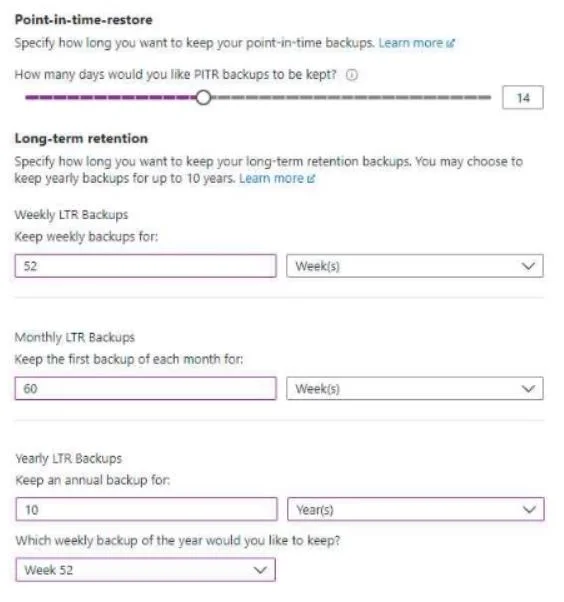
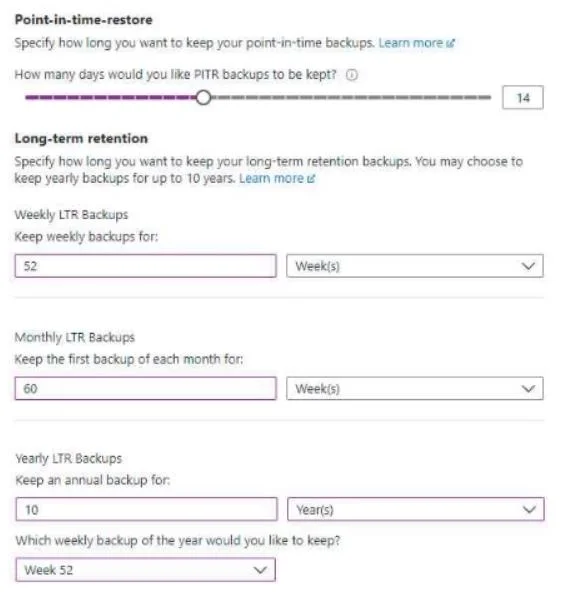
The exhibit's "Point-in-time-restore" section shows that PITR backups are kept for "14 days". Since a failure occurred two days ago, it falls within this 14-day retention period. Point-in-time restore (PITR) is designed to restore a database to any point in time within the retention period, which is ideal for recovering from recent failures with minimal data loss. Therefore, a point-in-time restore (PITR) backup is the correct choice.
Statement 2: "After the 52nd weekly backup runs, there will be [answer choice] backup copies in long term retention."
The exhibit shows the following Long-term retention (LTR) settings:
- Weekly LTR Backups: Keep weekly backups for 52 Week(s).
- Monthly LTR Backups: Keep the first backup of each month for 60 Month(s).
- Yearly LTR Backups: Keep an annual backup for 10 Year(s), specifically Week 52.
To calculate the total number of long-term retention backup copies, we consider the maximum number of distinct backups required by the overlapping policies:
- Monthly LTR: This policy retains 60 monthly backups, covering the last 5 years (60 months). This accounts for 60 distinct backup copies.
- Yearly LTR: This policy retains 10 yearly backups (the Week 52 backup for the last 10 years).
Since the monthly LTR policy covers the last 5 years, 5 of the 10 yearly backups (the Week 52 backups for the last 5 years) are already encompassed by the monthly retention period (meaning they fall within the 60 months). However, the yearly policy extends for another 5 years beyond the monthly policy (years 6 through 10). Thus, there are 5 additional yearly backups that are retained only by the yearly LTR policy.
Therefore, the total number of distinct backup copies is the sum of the monthly backups and the additional yearly backups not covered by the monthly policy:
- 60 (monthly backups)
-
- 5 (yearly backups for years 6-10, where there is no monthly retention)
- = 65 backup copies.
The 52 weekly backups are for the current year and would be largely covered by the more extensive monthly and yearly retention policies when calculating the total distinct LTR backups over multiple years.
Topics
Community Discussion
No community discussion yet for this question.