
DP-300 · Question #246
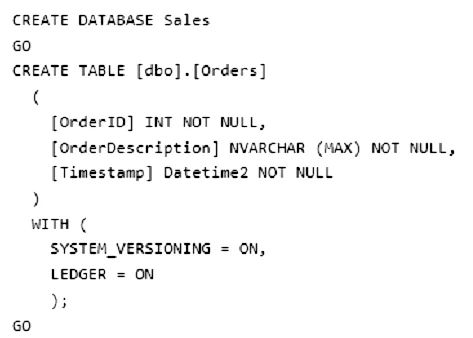
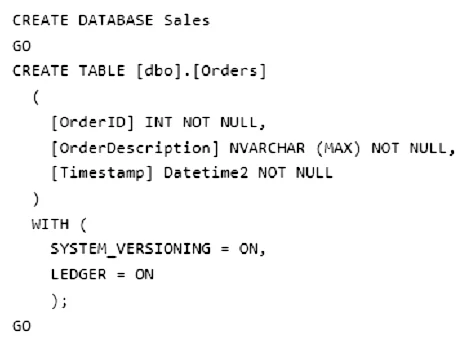
Hotspot Question You have an Azure SQL logical server. You run the following script. For each of the following statements, select Yes if the statement is true. Otherwise, select No. NOTE: Each…
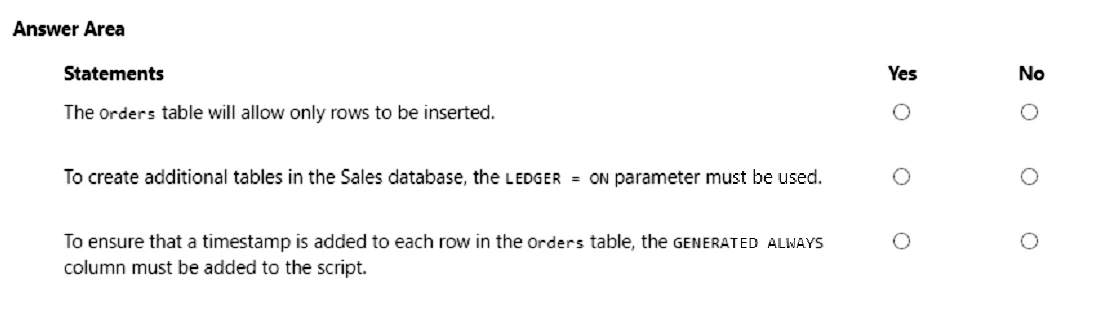
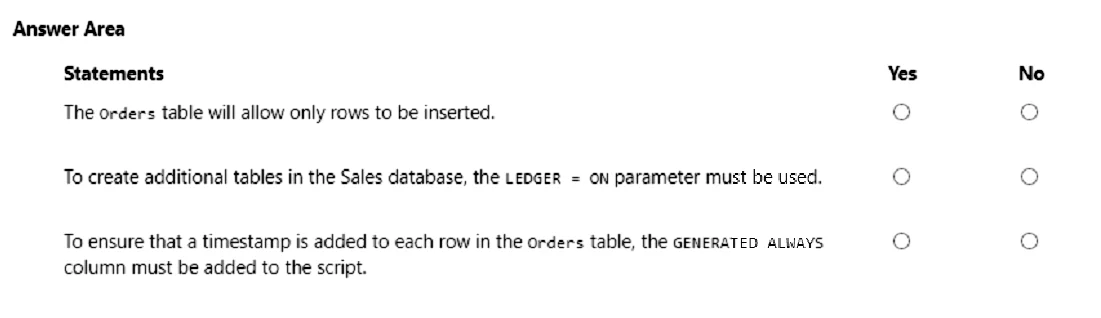
The correct answer is The Orders table will allow only rows to be inserted. = No; To create additional tables in the Sales database, the `LEDGER = ON` parameter must be used. = No; To ensure that a timestamp is added to each row in the Orders table, the `GENERATED ALWAYS` column must be added to the script. = Yes. Statement 3 is correct (Yes) because in Azure SQL Ledger tables, if you want system-generated timestamps (transaction timestamps) to be automatically recorded for each row, you must explicitly include GENERATED ALWAYS AS columns (such as ledger_start_transaction_time) in the…
Question
Exhibits
Answer Area
- The Orders table will allow only rows to be inserted.No
- To create additional tables in the Sales database, the
LEDGER = ONparameter must be used.No - To ensure that a timestamp is added to each row in the Orders table, the
GENERATED ALWAYScolumn must be added to the script.Yes
Explanation
Statement 3 is correct (Yes) because in Azure SQL Ledger tables, if you want system-generated timestamps (transaction timestamps) to be automatically recorded for each row, you must explicitly include GENERATED ALWAYS AS columns (such as ledger_start_transaction_time) in the table definition; without them, the timestamps won't be automatically added to the table itself. Statement 1 is incorrect (No) because an updatable ledger table (the default when LEDGER = ON without APPEND_ONLY = ON) allows INSERT, UPDATE, and DELETE operations - not just inserts; only APPEND_ONLY ledger tables restrict to inserts only. Statement 2 is incorrect (No) because when a database is created with LEDGER = ON at the database level, all tables created in that database are automatically ledger tables; individual tables do not need to specify LEDGER = ON separately, so the parameter is NOT required for each additional table creation.
Topics
Community Discussion
No community discussion yet for this question.