
DP-300 · Question #244
Hotspot Question You have an Azure SQL database named DB1 that contains a table named Orders. The Orders table contains a row for each sales order. Each sales order includes the name of the user who…
The correct answer is Create:: A security policy in the Orders table; Control access to the rows by using:: A table-valued function. To implement Row-Level Security (RLS) in Azure SQL Database, you must create a security policy and define a table-valued function to control row access based on user identity.
Question
Exhibits
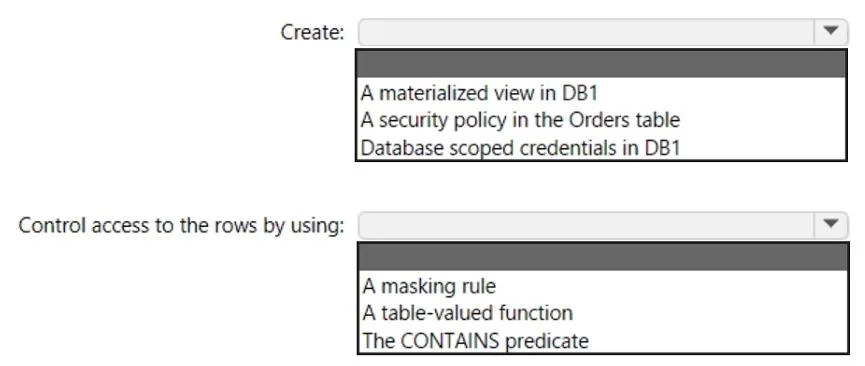
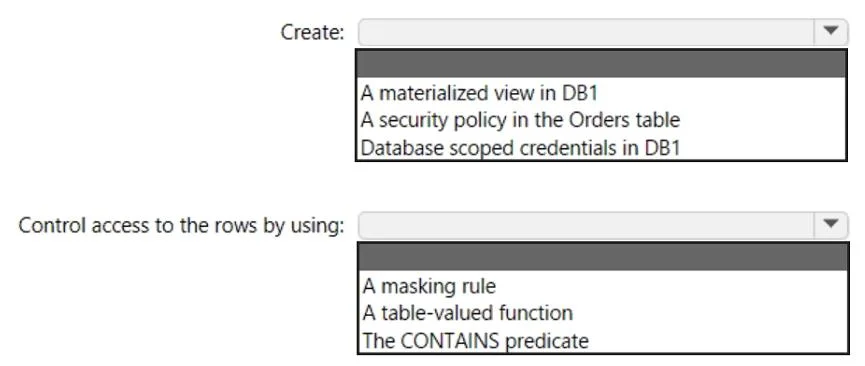
Answer Area
- Create:A security policy in the Orders tableA materialized view in DB1A security policy in the Orders tableDatabase scoped credentials in DB1
- Control access to the rows by using:A table-valued functionA masking ruleA table-valued functionThe CONTAINS predicate
Explanation
To implement Row-Level Security (RLS) in Azure SQL Database, you must create a security policy and define a table-valued function to control row access based on user identity.
Approach. To implement Row-Level Security (RLS) that ensures users only view their own sales orders in an Azure SQL database, two main components are required:
- Create: A security policy in the Orders table: A security policy is the fundamental object in SQL Server and Azure SQL Database used to implement RLS. It contains one or more security predicates and binds them to target tables (in this case, the
Orderstable) to filter rows based on the user's context. - Control access to the rows by using: A table-valued function: RLS predicates are typically defined using inline table-valued functions. This function encapsulates the logic that determines which rows a user can access (e.g., comparing a user column in
Ordersto theSESSION_USERorCURRENT_USER). The security policy then applies this function as a filter predicate to theOrderstable, ensuring only relevant rows are returned to the user.
Common mistakes.
- common_mistake. Common mistakes include confusing RLS with other security features or misunderstanding the components required:
- Materialized view: Materialized views are for performance optimization by pre-computing query results, not for enforcing row-level security or access control.
- Database scoped credentials: These are used for authenticating to external resources (like Azure Blob Storage) from within the database and are unrelated to filtering rows based on user identity.
- Masking rule: Dynamic Data Masking (DDM) is used to obscure sensitive column data (e.g., showing only the last 4 digits of a credit card number), not to filter rows based on who the user is. It addresses data obfuscation, not access control at the row level.
- The CONTAINS predicate: This is a full-text search function used for querying text columns and has no role in implementing RLS for user-specific row access.
Concept tested. The core concept tested is the implementation of Row-Level Security (RLS) in Azure SQL Database (or SQL Server), specifically understanding the primary components: security policies and predicate functions (typically inline table-valued functions) used to filter rows based on user context.
Topics
Community Discussion
No community discussion yet for this question.