
DP-100 · Question #228
Drag and Drop Question You have an Azure Machine Learning workspace that contains a CPU-based compute cluster and an Azure Kubernetes Services (AKS) inference cluster. You create a tabular dataset…
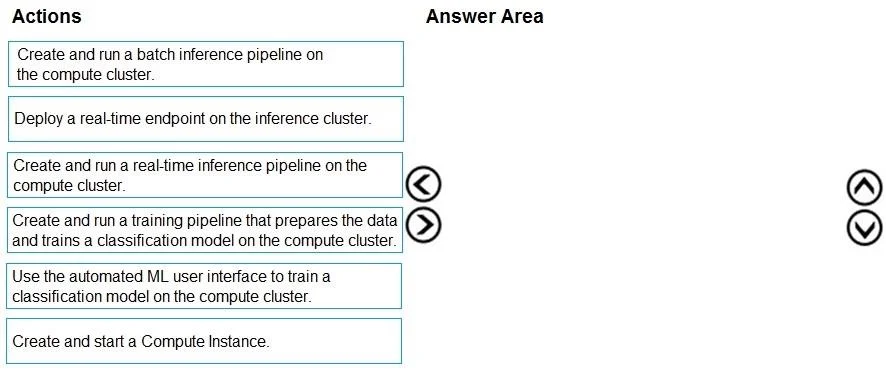
The correct answer is Create and start a Compute Instance.; Create and run a training pipeline that prepares the data and trains a classification model on the compute cluster.; Create and run a real-time inference pipeline on the compute cluster. To create a real-time web service from a classification model using Azure ML Designer, the test-taker must first train the model, then create and run a real-time inference pipeline, and finally deploy it as a real-time endpoint.
Question
Exhibit
Answer Area
Drag items
Correct arrangement
- Create and start a Compute Instance.
- Create and run a training pipeline that prepares the data and trains a classification model on the compute cluster.
- Create and run a real-time inference pipeline on the compute cluster.
Explanation
To create a real-time web service from a classification model using Azure ML Designer, the test-taker must first train the model, then create and run a real-time inference pipeline, and finally deploy it as a real-time endpoint.
Approach. The goal is to create a web service for real-time predictions using Azure ML Designer. This requires a specific sequence of operations:
-
Create and run a training pipeline that prepares the data and trains a classification model on the compute cluster. (This is the essential first step. Before a model can be used for inference, it must be trained. A training pipeline encapsulates the data preparation and model training process, using the specified CPU-based compute cluster.)
-
Create and run a real-time inference pipeline on the compute cluster. (Once a model is trained, it needs to be integrated into an inference pipeline specifically designed for real-time predictions. In Azure ML Designer, you typically convert a training pipeline into a real-time inference pipeline, which includes modules for input, pre-processing, scoring with the trained model, and output. Running this pipeline validates it and prepares it for deployment.)
-
Deploy a real-time endpoint on the inference cluster. (The final step is to deploy the completed real-time inference pipeline as a web service. This creates a real-time endpoint on the Azure Kubernetes Service (AKS) inference cluster, allowing client applications to send new data and receive immediate predictions.)
Common mistakes.
- common_mistake. Common mistakes include:
- Creating and running a batch inference pipeline: This is incorrect because the requirement is for a real-time web service, not batch predictions.
- Using the automated ML user interface: The question explicitly states to use the 'Azure Machine Learning designer', making automated ML an incorrect approach for this specific scenario.
- Creating and starting a Compute Instance: A Compute Instance is primarily a development workstation for notebooks. While compute resources are needed, the question implies that the necessary compute clusters (CPU-based for training/pipeline runs, AKS for inference deployment) are already available or handled by the pipeline execution, making a Compute Instance an unnecessary and out-of-sequence step for deploying a web service.
- Incorrect order of operations: Forgetting to train the model first, attempting to deploy before creating an inference pipeline, or confusing the order of training, inference pipeline creation, and deployment are common errors.
Concept tested. The end-to-end machine learning workflow in Azure Machine Learning, specifically focusing on model training, real-time inference pipeline creation, and deployment as a web service using Azure ML Designer and different compute targets (compute cluster for training, AKS for real-time inference deployment).
Topics
Community Discussion
No community discussion yet for this question.