
DP-100 · Question #165
Drag and Drop Question An organization uses Azure Machine Learning service and wants to expand their use of machine learning. You have the following compute environments. The organization does not…
The correct answer is nb_server; mlc_cluster. This question tests the ability to correctly map Azure Machine Learning compute environments to specific machine learning scenarios, distinguishing between compute types for training pipelines and web service deployment.
Question
Exhibit
Answer Area
Drag items
Correct arrangement
- nb_server
- mlc_cluster
Explanation
This question tests the ability to correctly map Azure Machine Learning compute environments to specific machine learning scenarios, distinguishing between compute types for training pipelines and web service deployment.
Approach. To answer the question, drag the appropriate compute environments to their corresponding scenarios:
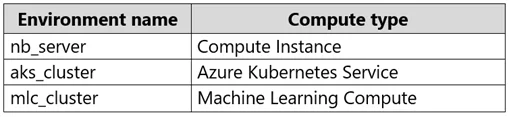
- For 'Run an Azure Machine Learning Designer training pipeline': Drag 'mlc_cluster' to this scenario. According to the 'Compute type' table (Exhibit 2), 'mlc_cluster' is 'Machine Learning Compute', which is synonymous with an Azure Machine Learning compute cluster. The 'Training targets' table (Exhibit 3) explicitly states that 'Azure Machine Learning compute cluster' supports 'Azure Machine Learning designer'. Compute clusters are ideal for scalable, managed training pipelines.
- For 'Deploying a web service from the Azure Machine Learning designer': Drag 'aks_cluster' to this scenario. The 'Compute type' table (Exhibit 2) identifies 'aks_cluster' as 'Azure Kubernetes Service'. AKS is the recommended and standard compute target in Azure Machine Learning for deploying production-grade machine learning models as web services due to its features for scalability, high availability, and management.
Common mistakes.
- common_mistake. Common mistakes include:
- Using 'nb_server' for 'Run an Azure Machine Learning Designer training pipeline': While a 'Compute Instance' ('nb_server') can technically run training pipelines (as indicated in Exhibit 3), a 'Machine Learning Compute' (cluster, represented by 'mlc_cluster') is generally the more robust and scalable choice for a 'pipeline' which implies potentially distributed or larger-scale training. Compute instances are typically for interactive development and testing.
- Using 'nb_server' or 'mlc_cluster' for 'Deploying a web service': Neither a Compute Instance ('nb_server') nor a Machine Learning Compute (cluster, 'mlc_cluster') is designed for deploying production-grade web services. Compute Instances are primarily for development environments, and Compute Clusters are primarily for training. AKS is specifically built for hosting production microservices, including ML models.
- Using 'aks_cluster' for 'Run an Azure Machine Learning Designer training pipeline': Azure Kubernetes Service (AKS) is primarily an inference/deployment target for Azure ML models. While it can be configured for training, it is not the typical or most straightforward choice for 'Azure Machine Learning Designer training pipelines' when dedicated training compute (like Compute Clusters or Instances) is available, and Exhibit 3 does not list it as a training target for the Designer.
Concept tested. The core concept tested is the understanding of different Azure Machine Learning compute targets, their characteristics, and their appropriate use cases for various stages of the machine learning lifecycle, specifically distinguishing between compute for training (pipelines) and compute for model deployment (web services) within the Azure Machine Learning ecosystem.
Topics
Community Discussion
No community discussion yet for this question.