
DP-100 · Question #160
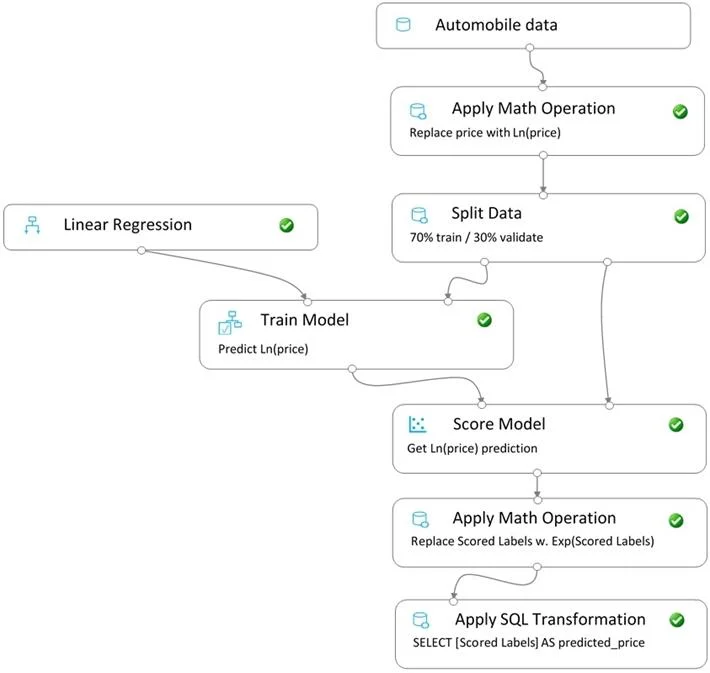
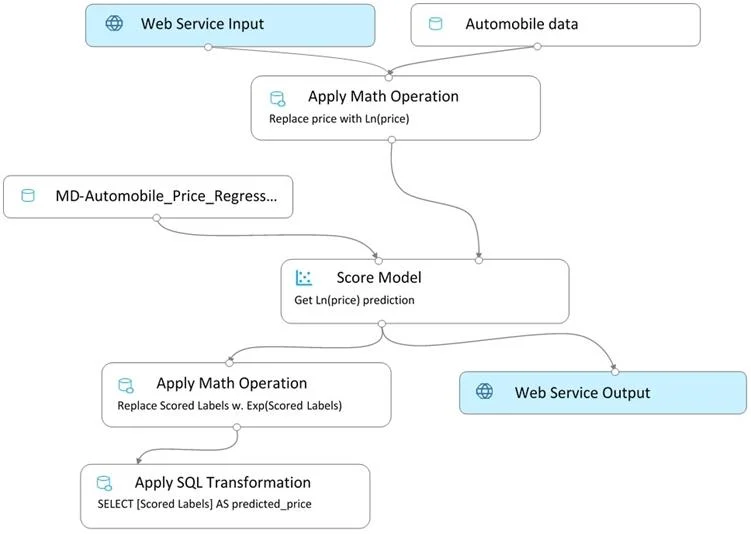
You create a pipeline in designer to train a model that predicts automobile prices. Because of non-linear relationships in the data, the pipeline calculates the natural log (Ln) of the prices in the…
The correct answer is A. Connect the output of the Apply SQL Transformation to the Web Service Output module. C. Add a Select Columns module before the Score Model module to select all columns other than E. Remove the Apply Math Operation module that replaces price with its natural log from the data. Modifying an Azure ML Designer real-time inference pipeline requires removing training-only transformations, excluding the target column from client input, and routing the exp() output to the web service.
Question
Exhibits
Options
- AConnect the output of the Apply SQL Transformation to the Web Service Output module.
- BReplace the Web Service Input module with a data input that does not include the price column.
- CAdd a Select Columns module before the Score Model module to select all columns other than
- DReplace the training dataset module with a data input that does not include the price column.
- ERemove the Apply Math Operation module that replaces price with its natural log from the data
- FRemove the Apply SQL Transformation module from the data flow.
How the community answered
(55 responses)- A76% (42)
- B4% (2)
- D15% (8)
- F5% (3)
Why each option
Modifying an Azure ML Designer real-time inference pipeline requires removing training-only transformations, excluding the target column from client input, and routing the exp() output to the web service.
Connecting the Apply SQL Transformation output - which computes exp(scored label) - directly to the Web Service Output module ensures the endpoint returns the predicted price in the original dollar scale rather than the log-transformed value.
Replacing the Web Service Input with a static data input would break the real-time nature of the endpoint and prevent clients from dynamically submitting their own automobile feature data for scoring.
Adding a Select Columns module before Score Model to exclude the price column ensures client applications submitting inference requests are not required to provide the actual price, which is the target variable being predicted.
Replacing the training dataset module affects the training data source only and has no impact on what inputs client applications must provide when calling the deployed inference endpoint.
The Apply Math Operation computing ln(price) was necessary only during training to transform the target variable; removing it from the inference pipeline eliminates any dependency on a real price input from clients at scoring time.
Removing the Apply SQL Transformation module eliminates the exp() calculation entirely, causing the web service to return the raw log-transformed score instead of the actual predicted automobile price.
Concept tested: Azure ML Designer real-time inference pipeline modification for log-transformed targets
Source: https://learn.microsoft.com/en-us/azure/machine-learning/concept-designer
Topics
Community Discussion
No community discussion yet for this question.