
D-SNC-DY-00 · Question #24
Drag and Drop Question What is the correct order of steps for data flow in asymmetric IRB frame encapsulation? Answer:
The correct answer is Ingress VTEP performs a route lookup that is based on the destination IP address.; Ingress VTEP encapsulates the packet from VXLAN and sends it on the appropriate VNI segment.; Egress VTEP determines that the host is local to the VNI and switches the packet.; Egress VTEP bridges the packet after decapsulation. Asymmetric IRB Frame Encapsulation - Step-by-Step Breakdown What is Asymmetric IRB? Asymmetric IRB (Integrated Routing and Bridging) is a VXLAN data-plane model where the ingress VTEP handles both L3 routing and L2 bridging, while the egress VTEP only handles L2 bridging. The…
Question
Drag and Drop Question What is the correct order of steps for data flow in asymmetric IRB frame encapsulation? Answer:
Exhibit
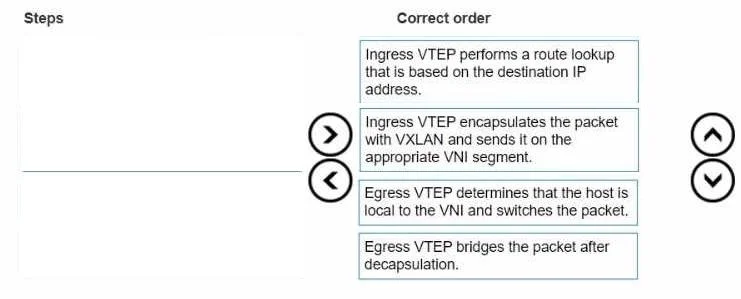
Answer Area
Drag items
Correct arrangement
- Ingress VTEP performs a route lookup that is based on the destination IP address.
- Ingress VTEP encapsulates the packet from VXLAN and sends it on the appropriate VNI segment.
- Egress VTEP determines that the host is local to the VNI and switches the packet.
- Egress VTEP bridges the packet after decapsulation.
Explanation
Asymmetric IRB Frame Encapsulation - Step-by-Step Breakdown
What is Asymmetric IRB?
Asymmetric IRB (Integrated Routing and Bridging) is a VXLAN data-plane model where the ingress VTEP handles both L3 routing and L2 bridging, while the egress VTEP only handles L2 bridging. The path is "asymmetric" because each direction does a different amount of work.
Why This Order?
Step 1: Ingress VTEP performs a route lookup based on the destination IP address
Why first? The ingress VTEP acts as the default gateway for its locally attached hosts. When a host sends traffic destined for a different subnet, the VTEP must first make an L3 routing decision - it needs to identify which VNI segment corresponds to the destination subnet before it can do anything else. You cannot encapsulate without knowing where to send the packet.
Step 2: Ingress VTEP encapsulates the packet and sends it on the appropriate VNI segment
Why second? Only after the route lookup does the ingress VTEP know the destination VNI. It then:
- Rewrites the MAC header (L3 routing action)
- Encapsulates the frame in a VXLAN header using the destination's VNI (not the source VNI - this is the key asymmetric IRB behavior)
- Forwards it across the underlay to the egress VTEP
This is the defining characteristic of asymmetric IRB: the packet travels on the destination VNI, meaning the egress VTEP only needs to bridge.
Step 3: Egress VTEP determines that the host is local to the VNI and switches the packet
Why third? The egress VTEP receives the VXLAN-encapsulated packet and performs a local MAC/L2 lookup against the VNI. Because the ingress VTEP already routed to the correct VNI, the egress VTEP finds the destination host as a locally attached endpoint - no routing is needed on this side. It makes the Layer 2 switching decision here.
Step 4: Egress VTEP bridges the packet after decapsulation
Why last? Once the forwarding decision is made, the egress VTEP strips the VXLAN header and bridges the original Ethernet frame out the correct local port to the destination host. Decapsulation is the final action before local delivery.
Common Mistakes and Misconceptions
| Misconception | Reality |
|---|---|
| Confusing asymmetric with symmetric IRB | In symmetric IRB, both VTEPs route. In asymmetric, only the ingress does. The egress is always pure L2. |
| Putting encapsulation before route lookup | You must know which VNI to use before you can encapsulate. Route lookup is always prerequisite. |
| Assuming egress does a route lookup | It doesn't - this is the whole point of asymmetric IRB. The egress VTEP only bridges. |
| Thinking the source VNI is used for encapsulation | The packet travels on the destination VNI, which is why the egress only needs to bridge locally. |
| Reversing steps 3 and 4 | The logical decision (step 3) precedes the physical action of stripping the header and delivering (step 4). |
Topics
Community Discussion
No community discussion yet for this question.