
CV0-002 · Question #588
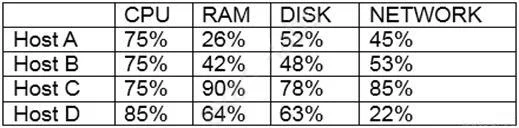
A systems administrator has created several new VMs on a private cloud and wants to ensure the new baseline still meets corporate guidelines. The administrator finds these new load metrics on the…
The correct answer is D. Memory. When implementing an N+1 host capacity policy, memory is the resource most likely to represent an issue after adding new VMs, as it is often less flexible for oversubscription than CPU or network resources.
Question
A systems administrator has created several new VMs on a private cloud and wants to ensure the new baseline still meets corporate guidelines. The administrator finds these new load metrics on the hosts:
If corporate policy requires N+1 host capacity, which of the following metrics is MOST likely to represent an issue?
Exhibit
Options
- AProcessor
- BNetwork
- CStorage
- DMemory
How the community answered
(24 responses)- A8% (2)
- B13% (3)
- C29% (7)
- D50% (12)
Why each option
When implementing an N+1 host capacity policy, memory is the resource most likely to represent an issue after adding new VMs, as it is often less flexible for oversubscription than CPU or network resources.
Processor (CPU) is typically more flexible for oversubscription in virtual environments, making it less likely to be the primary N+1 bottleneck compared to memory.
Network capacity can often be scaled or optimized with additional hardware or configuration, making it less likely to be the first resource to violate N+1 host capacity.
Storage capacity or I/O is often managed by external shared storage and while critical, the immediate N+1 concern for *host* capacity often focuses on compute resources like memory and CPU.
Memory is frequently the bottleneck in N+1 host capacity planning for virtualized environments because it is often provisioned as a dedicated resource per VM with limited oversubscription capabilities. If the total memory required by all VMs, plus the capacity needed to accommodate VMs from a failed host, exceeds the physical RAM of the remaining hosts, it signifies an N+1 violation.
Concept tested: N+1 Host Capacity Planning for Private Cloud
Source: https://docs.vmware.com/en/VMware-vSphere/8.0/vsphere-esxi-vcenter-server-803-host-management-guide/GUID-B0D194B4-CC84-486A-8A47-194BFB323E73.html
Topics
Community Discussion
No community discussion yet for this question.