
CV0-002 · Question #488
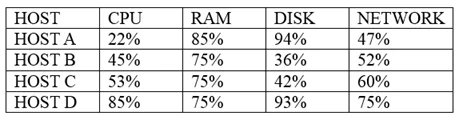
A systems administrator created several new VMs on a private cloud and wants to ensure the new baseline still meets corporate guidelines. The administrator finds the following new load numbers on…
The correct answer is C. DISK. In an N+1 host capacity scenario, ensuring resilience requires the underlying infrastructure to withstand the failure of one host while maintaining performance, with shared storage performance frequently being the bottleneck.
Question
A systems administrator created several new VMs on a private cloud and wants to ensure the new baseline still meets corporate guidelines. The administrator finds the following new load numbers on the hosts:
If corporate policy requires N+1 host capacity, which of the following metrics is MOST likely to present a problem?
Exhibit
Options
- ACPU
- BRAM
- CDISK
- DNETWORK
How the community answered
(45 responses)- A4% (2)
- B20% (9)
- C64% (29)
- D11% (5)
Why each option
In an N+1 host capacity scenario, ensuring resilience requires the underlying infrastructure to withstand the failure of one host while maintaining performance, with shared storage performance frequently being the bottleneck.
CPU resources are often efficiently overcommitted by hypervisors, and modern systems typically have sufficient CPU headroom for N+1 scenarios unless extremely oversaturated.
While RAM is a hard constraint, it is generally easier to plan and ensure sufficient free capacity on remaining hosts for an N+1 event compared to unpredictable and bursty disk I/O.
In a virtualized environment with N+1 host capacity, disk I/O operations per second (IOPS) are frequently the most constrained resource when consolidating workloads due to a host failure, as the aggregate I/O demand from all virtual machines often pushes shared storage systems to their performance limits.
Network bandwidth for VM data traffic is usually well-provisioned and often has more headroom than storage I/O performance, making it less likely to be the primary bottleneck during an N+1 event.
Concept tested: N+1 host capacity planning and virtualization bottlenecks
Topics
Community Discussion
No community discussion yet for this question.