
CTFL_SYLL_4.0 · Question #136
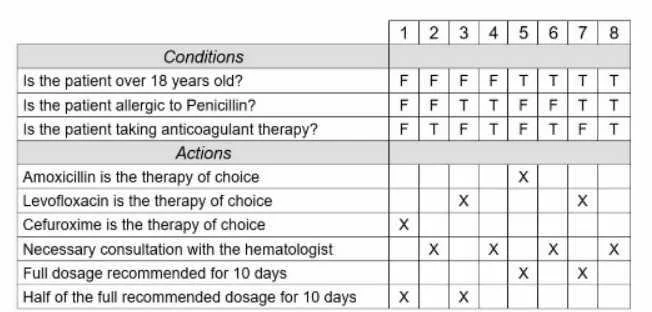
The following decision table is used to assist a doctor in determining the drug therapy to prescribe for a patient (aged 6 to 65 years) diagnosed with acute sinusitis. The table consists of three…
The correct answer is B. Columns 1 and 3 can be merged into a single column. Decision tables are used to model complex decision logic by considering different combinations of conditions and actions. Based on the given decision table for prescribing drug therapy: Column 1 and Column 3 both result in the same actions (prescribing Amoxicillin). These…
Question
The following decision table is used to assist a doctor in determining the drug therapy to prescribe for a patient (aged 6 to 65 years) diagnosed with acute sinusitis. The table consists of three Boolean conditions and six actions:
Based only on the given information, which of the following statements is TRUE?
Exhibit
Options
- AColumn 7 represents an impossible situation and thus can be deleted
- BColumns 1 and 3 can be merged into a single column
- CColumns 2, 4, 6 and 8 can be merged into a single column
- DColumns 5 and 7 can be merged into a single column
How the community answered
(28 responses)- A7% (2)
- B54% (15)
- C11% (3)
- D29% (8)
Explanation
Decision tables are used to model complex decision logic by considering different combinations of conditions and actions. Based on the given decision table for prescribing drug therapy: Column 1 and Column 3 both result in the same actions (prescribing Amoxicillin). These columns can be merged because the actions taken do not depend on whether the patient is taking anticoagulant therapy (both are 'T' for this condition). Thus, combining these columns simplifies the decision table without losing any information.
Topics
Community Discussion
No community discussion yet for this question.