
CTAL-TTA_001 · Question #27
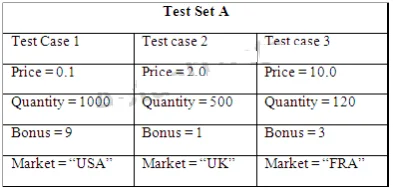
The developers have suggested test set A is adequate to test the program opposite: When executing test set A through the program which statements are exercised? 2 credits [K3]
The correct answer is D. All, but statement 22, 27, 28 and 29. Option D is correct because when tracing test set A through the program, two separate branches are never triggered: the branch containing statement 22 (likely a condition whose alternate path is never taken by any test case in set A), and the block containing statements 27, 28…
Question
The developers have suggested test set A is adequate to test the program opposite:
When executing test set A through the program which statements are exercised? 2 credits [K3]
Exhibit
Options
- AAll
- BAll, but statement 22
- CAll, but statement 27, 28 and 29
- DAll, but statement 22, 27, 28 and 29
How the community answered
(24 responses)- A8% (2)
- B17% (4)
- C4% (1)
- D71% (17)
Explanation
Option D is correct because when tracing test set A through the program, two separate branches are never triggered: the branch containing statement 22 (likely a condition whose alternate path is never taken by any test case in set A), and the block containing statements 27, 28, and 29 (likely a conditional block, such as an else or error-handling path, that no test case in set A enters). This means four statements in total are skipped, leaving statement coverage incomplete.
Why the distractors fail:
- A is wrong because test set A does not achieve 100% statement coverage - the whole point of the question is to identify the gaps.
- B is wrong because it only accounts for the missing statement 22, ignoring that statements 27–29 are also unexercised.
- C is wrong because it only accounts for the missing block (27–29), ignoring statement 22.
Memory tip: Think of it as two separate "dead zones" in the code that test set A never enters - one lone statement (22) and one small block (27–29). When you see a question like this, systematically trace each test case through every branch and mark which statements get hit; the uncovered ones across all test cases combined give you your answer. If you miss either dead zone, you'll pick B or C instead of D.
Topics
Community Discussion
No community discussion yet for this question.