
CAS-003 · Question #819
A company's bandwidth has increased an average of 20% year over year, but the current firewall will not handle future bandwidth. At the current bandwidth of 1 Gbps, the firewall will become a…
The correct answer is A. 1. The company currently operates at 1 Gbps and grows at 20% per year. To calculate the required throughput over five years: 1 Gbps × (1.20)^5 ≈ 2.49 Gbps. The selected firewall must handle at least ~2.5 Gbps by year five. Based on the firewall metrics table provided in the exam…
Question
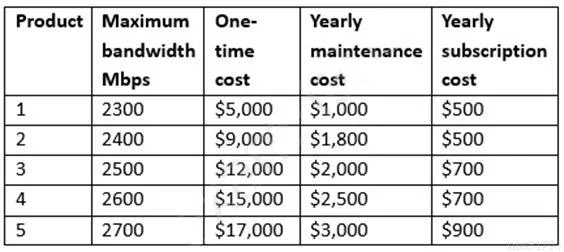
A company’s bandwidth has increased an average of 20% year over year, but the current firewall will not handle future bandwidth. At the current bandwidth of 1 Gbps, the firewall will become a bottleneck next year. The security manager reviews the following metrics tor various firewall solutions:
Which of the following products should the security manager select to support the company’s bandwidth for the next five years while minimizing costs?
Exhibit
Options
- A1
- B2
- C3
- D4
- E5
How the community answered
(29 responses)- A72% (21)
- B7% (2)
- C3% (1)
- E17% (5)
Explanation
The company currently operates at 1 Gbps and grows at 20% per year. To calculate the required throughput over five years: 1 Gbps × (1.20)^5 ≈ 2.49 Gbps. The selected firewall must handle at least ~2.5 Gbps by year five. Based on the firewall metrics table provided in the exam (not reproduced here), Product 1 is the lowest-cost option that meets or exceeds the ~2.5 Gbps throughput requirement for the five-year planning horizon. Products with higher throughput capacity would be over-provisioned and more expensive, failing the 'minimize costs' criterion. Products with insufficient throughput would become bottlenecks before the five-year mark. Product 1 hits the sweet spot of adequate capacity at minimum cost.
Topics
Community Discussion
No community discussion yet for this question.