
CAS-003 · Question #635
A technician uses an old SSL server due to budget constraints and discovers performance degrades dramatically after enabling PFS. The technician cannot determine why performance degraded so…
The correct answer is B. Using RSA. RSA-based cipher suites that enable PFS via DHE-RSA are extremely CPU-intensive, and older hardware without cryptographic acceleration suffers severe performance degradation compared to ECC-based ECDHE.
Question
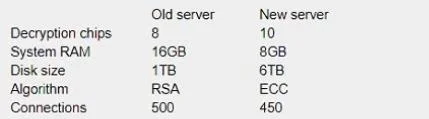
A technician uses an old SSL server due to budget constraints and discovers performance degrades dramatically after enabling PFS. The technician cannot determine why performance degraded so dramatically. A newer version of the SSL server does not suffer the same performance degradation. Performance rather than security is the main priority for the technician The system specifications and configuration of each system are listed below:
Which of the following is MOST likely the cause of the degradation in performance and should be changed?
Exhibit
Options
- AUsing ECC
- BUsing RSA
- CDisk size
- DMemory size
- EDecryption chips
- FConnection requests
How the community answered
(43 responses)- B67% (29)
- C16% (7)
- D9% (4)
- E5% (2)
- F2% (1)
Why each option
RSA-based cipher suites that enable PFS via DHE-RSA are extremely CPU-intensive, and older hardware without cryptographic acceleration suffers severe performance degradation compared to ECC-based ECDHE.
ECC reduces computational overhead compared to RSA and would improve, not degrade, PFS performance.
PFS requires ephemeral key generation on every session, and DHE-RSA achieves this using large RSA key moduli with expensive modular exponentiation operations. Older servers lacking hardware crypto acceleration must perform these operations entirely in software, causing dramatic throughput drops. Newer servers typically default to ECDHE, which achieves equivalent PFS security with far lower computational cost due to smaller key sizes in elliptic curve math.
Disk size has no bearing on SSL/TLS handshake cryptographic operations or key exchange performance.
Memory size affects concurrent session capacity but does not drive per-handshake cryptographic overhead.
Decryption chips (hardware acceleration) would speed up cryptographic operations and reduce degradation, not cause it.
Connection request volume is a load metric and not a configurable option that explains the underlying cryptographic performance bottleneck.
Concept tested: RSA vs ECC performance impact on PFS cipher suites
Source: https://learn.microsoft.com/en-us/windows-server/security/tls/tls-ssl-schannel-ssp-overview
Topics
Community Discussion
No community discussion yet for this question.