
AZ-400 · Question #8
Case Study 2 - Contoso, Ltd Background Contoso, Ltd. is a manufacturing company that has a main office in Chicago. Contoso plans to improve its IT development and operations processes by…
The correct sequence for implementing Azure Automation DSC follows three mandatory steps in order: First, create a DSC configuration file with a .ps1 extension (Box1), which defines the desired state using PowerShell DSC syntax. Second, import that configuration into Azure…
Question
Exhibit
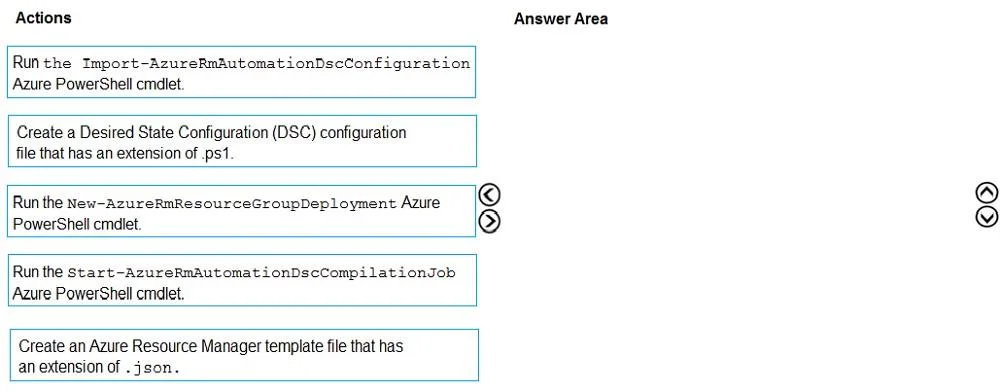
Options
- Box1Create a Desired State Configuration (DSC) configuration file that has an extension of .ps1.
- Box2Run the Import-AzureRmAutomationDscConfiguration Azure PowerShell cmdlet.
- Box3Run the Start-AzureRmAutomationDscCompilationJob Azure PowerShell cmdlet.
Explanation
The correct sequence for implementing Azure Automation DSC follows three mandatory steps in order: First, create a DSC configuration file with a .ps1 extension (Box1), which defines the desired state using PowerShell DSC syntax. Second, import that configuration into Azure Automation using the Import-AzureRmAutomationDscConfiguration cmdlet (Box2), which uploads the .ps1 file to the Automation account. Third, compile the configuration into a node configuration (MOF file) using Start-AzureRmAutomationDscCompilationJob (Box3), which makes the configuration available to assign to managed nodes. This workflow is the standard Azure Automation DSC onboarding process required before any node can be configured.
Topics
Community Discussion
No community discussion yet for this question.