
AZ-400 · Question #589
Hotspot Question You deploy multiple apps by using Azure Pipelines. You need to recommend a solution to manage the configuration of the apps. The solution must meet the following requirements…
Azure App Configuration & Deployment Slots - Hotspot Explanation The correct answers are: | Requirement | Answer | |---|---| | Share feature flags across multiple apps | Azure App Configuration | | Deploy configurations to different deployment slots | Azure App Service settings…
Question
Exhibit
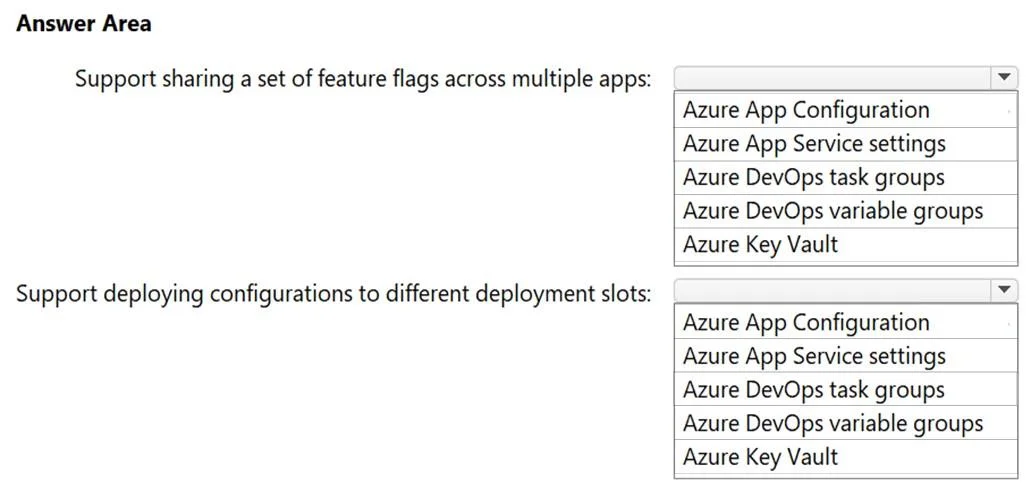
Answer Area
- Support sharing a set of feature flags across multiple apps:Azure App ConfigurationAzure App Service settingsAzure DevOps task groupsAzure DevOps variable groupsAzure Key Vault
- Support deploying configurations to different deployment slots:Azure App ConfigurationAzure App Service settingsAzure DevOps task groupsAzure DevOps variable groupsAzure Key Vault
Explanation
Azure App Configuration & Deployment Slots - Hotspot Explanation
The correct answers are:
| Requirement | Answer |
|---|---|
| Share feature flags across multiple apps | Azure App Configuration |
| Deploy configurations to different deployment slots | Azure App Service settings |
Dropdown 1: Feature Flags Across Multiple Apps -> Azure App Configuration
Why it's correct: Azure App Configuration is a centralized service specifically built for managing application settings and feature flags. It provides a dedicated Feature Manager with built-in flag lifecycle management (targeting filters, percentage rollouts, time windows). Multiple apps - across different languages, frameworks, or services - connect to a single App Configuration store via connection string or Managed Identity, sharing the same flag definitions without duplication.
Why the others are wrong:
- Azure App Service settings - Scoped to a single App Service instance. No native feature flag support; no sharing mechanism across apps.
- Azure DevOps task groups - Reusable pipeline task templates. Not a runtime configuration store; irrelevant to feature flags.
- Azure DevOps variable groups - Pipeline build/release variables. Not accessible at runtime by apps; not designed for feature flag semantics.
- Azure Key Vault - Stores secrets and certificates. Has no feature flag concept; designed for sensitive credential storage, not behavioral toggles.
Dropdown 2: Configurations to Different Deployment Slots -> Azure App Service settings
Why it's correct:
Azure App Service deployment slots (staging, production, QA, etc.) each have their own App Service settings. Critically, individual settings can be marked as slot-sticky - they remain bound to the slot and do not swap when you perform a slot swap. This lets staging have DB_CONNECTION=staging-db and production have DB_CONNECTION=prod-db, surviving slot swaps independently.
Why the others are wrong:
- Azure App Configuration - Supports labels per environment, but does not natively map to or swap with App Service deployment slots.
- Azure DevOps task groups - Pipeline-level construct; has no awareness of or integration with App Service slots at runtime.
- Azure DevOps variable groups - Inject variables at pipeline execution time only; not persisted as slot-specific runtime config.
- Azure Key Vault - Stores secrets centrally; cannot be scoped or differentiated per deployment slot natively.
Core technical concept: Azure App Configuration solves the cross-app, centralized config problem; App Service settings with slot stickiness solve the per-environment isolation within a single app problem. These are complementary, not competing, services.
Topics
Community Discussion
No community discussion yet for this question.