
AZ-400 · Question #558
Note: This question is part of a series of questions that present the same scenario. Each question in the series contains a unique solution that might meet the stated goals. Some question sets might…
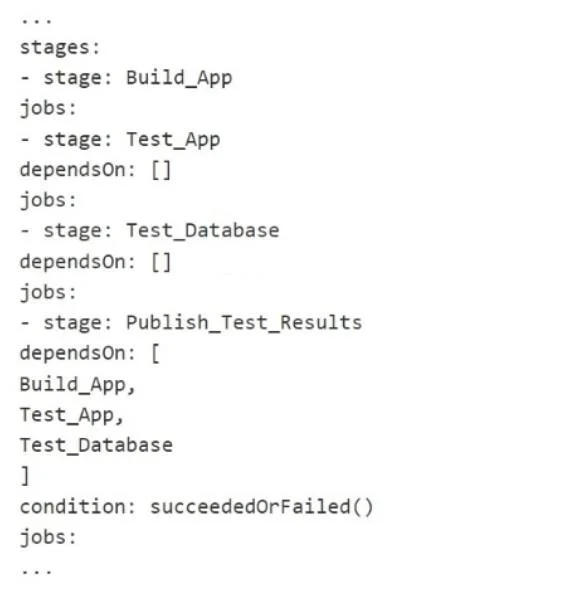
The correct answer is B. No. Option B (No) is correct because the solution as presented does not fully satisfy all the stated requirements - most likely because the YAML definition shown either lacks the proper dependsOn configuration, missing condition: always() for the Publish_Test_Results stage, or…
Question
Exhibits
Options
- AYes
- BNo
How the community answered
(38 responses)- A21% (8)
- B79% (30)
Explanation
Option B (No) is correct because the solution as presented does not fully satisfy all the stated requirements - most likely because the YAML definition shown either lacks the proper dependsOn configuration, missing condition: always() for the Publish_Test_Results stage, or doesn't correctly configure parallel execution using independent dependsOn references to the build stage for both test stages.
To meet the goals, each test stage must explicitly declare dependsOn: Build_Stage (so they run in parallel after the build), and Publish_Test_Results must declare dependsOn on both test stages with condition: always() to ensure it runs regardless of test stage outcomes.
Why Option A is wrong: "Yes" would only be correct if the YAML included all four elements correctly: parallel test stages both depending on the build stage, and Publish_Test_Results depending on all test stages with an always() condition - which the proposed solution fails to fully implement.
Memory Tip: Remember the acronym PPAD - Parallel tests, Post-build dependency, Always-run publish, DependsOn chaining. If any of these four elements is missing or misconfigured in the YAML, the answer is No.
Topics
Community Discussion
No community discussion yet for this question.