
AZ-400 · Question #429
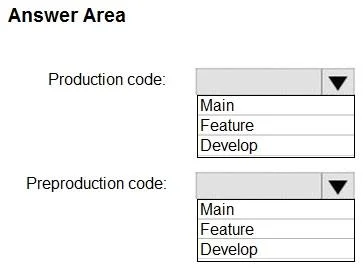
Hotspot Question You company uses a Git source-code repository. You plan to implement GitFlow as a workflow strategy. You need to identify which branch types are used for production code and…
The correct answer is Production code:: Main; Preproduction code:: Develop. This question tests knowledge of the GitFlow branching strategy, specifically which branch types serve production and preproduction code purposes. GitFlow defines distinct branch roles for different stages of the software lifecycle.
Question
Exhibit
Answer Area
- Production code:MainMainFeatureDevelop
- Preproduction code:DevelopMainFeatureDevelop
Explanation
This question tests knowledge of the GitFlow branching strategy, specifically which branch types serve production and preproduction code purposes. GitFlow defines distinct branch roles for different stages of the software lifecycle.
Approach. In GitFlow, the 'main' (or 'master') branch always reflects production-ready code - it contains only released, stable code that has been deployed to production. The 'develop' branch serves as the integration branch for preproduction code, where completed features are merged and tested before being released. Feature branches merge into develop, and when develop is ready for release, it is merged into main via a release branch. Therefore: Production code = main branch, Preproduction code = develop branch.
Concept tested. GitFlow branching strategy: In GitFlow, 'main/master' is the production branch containing release-tagged commits, while 'develop' is the preproduction integration branch. Other branch types include feature branches (short-lived, merge into develop), release branches (stabilization before merging to main), and hotfix branches (emergency fixes off main). Understanding these roles is critical for implementing proper CI/CD pipelines and branch protection policies in Azure DevOps.
Reference. GitFlow Workflow by Vincent Driessen (nvie.com); Microsoft Learn - Implement GitFlow strategy in Azure DevOps
Topics
Community Discussion
No community discussion yet for this question.