
AZ-400 · Question #259
Hotspot Question You use Azure Pipelines to manage the build and deployment of apps. You are planning the release strategies for a new app. You need to choose strategies for the following scenarios…
This question tests knowledge of Azure DevOps release strategies and their appropriate use cases, requiring candidates to match each deployment scenario to the correct strategy.
Question
Exhibit
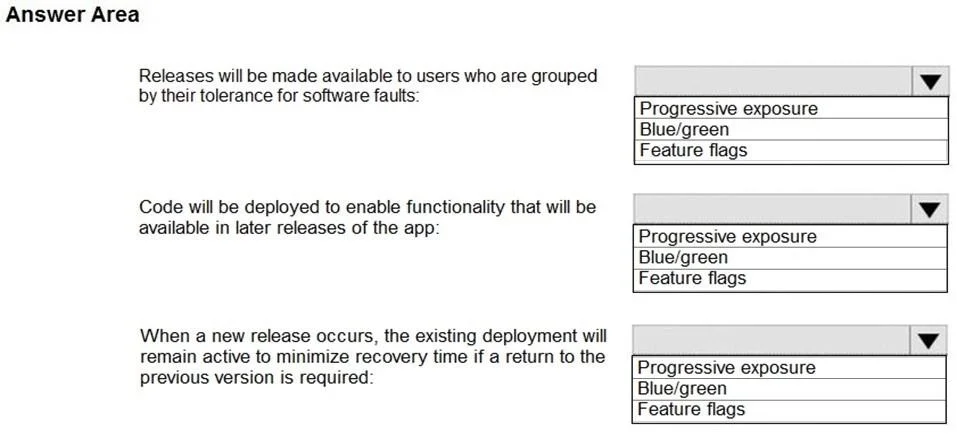
Answer Area
- Releases will be made available to users who are grouped by their tolerance for software faults:Progressive exposureBlue/greenFeature flags
- Code will be deployed to enable functionality that will be available in later releases of the app:Progressive exposureBlue/greenFeature flags
- When a new release occurs, the existing deployment will remain active to minimize recovery time if a return to the previous version is required:Progressive exposureBlue/greenFeature flags
Explanation
This question tests knowledge of Azure DevOps release strategies and their appropriate use cases, requiring candidates to match each deployment scenario to the correct strategy.
Approach. Scenario 1 (users grouped by fault tolerance) = Progressive Exposure / Ring-based deployment: This strategy segments users into rings or groups based on their tolerance for instability, rolling out releases progressively from inner rings (early adopters) to outer rings (general users). Scenario 2 (code deployed for future functionality) = Feature Flags (also called Feature Toggles/Dark Launching): This strategy allows code to be merged and deployed to production but kept hidden/disabled via configuration flags, enabling the functionality only when it is ready for release. Scenario 3 (existing deployment remains active to minimize recovery time) = Blue-Green Deployment: This strategy maintains two identical environments (blue = current, green = new), so if the new release has issues, traffic can be instantly routed back to the previous active environment, minimizing downtime and recovery time.
Concept tested. Azure DevOps release and deployment strategies including Ring-based/Progressive Exposure deployments, Feature Flags/Toggles (Dark Launching), and Blue-Green deployments, and understanding when each strategy is appropriate based on business and technical requirements.
Reference. Microsoft Learn - Release strategies in Azure Pipelines: https://learn.microsoft.com/en-us/azure/devops/pipelines/release/deploy-multiple-branches
Topics
Community Discussion
No community discussion yet for this question.