
AZ-120 · Question #225
Drag and Drop Question You plan to deploy SAP on Azure. The deployment must meet the following requirements: - Support failover to another Azure region in the event of a regional outage. - Minimize…
The correct answer is Azure Site Recovery; Native replication. SAP on Azure Fault Tolerance - Explained The Setup Two components need cross-region DR solutions: | Target | Correct Technology | |---|---| | SAP Web Dispatcher | Azure Site Recovery | | Microsoft SQL Server 2017 | Native replication | --- Why Azure Site Recovery for SAP Web…
Question
Exhibit
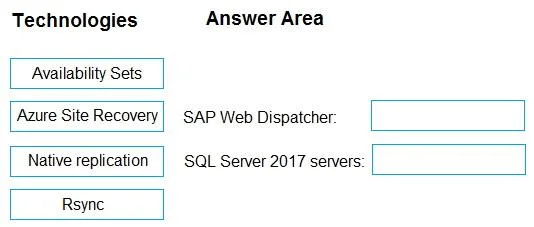
Answer Area
Drag items
Correct arrangement
- Azure Site Recovery
- Native replication
Explanation
SAP on Azure Fault Tolerance - Explained
The Setup
Two components need cross-region DR solutions:
| Target | Correct Technology |
|---|---|
| SAP Web Dispatcher | Azure Site Recovery |
| Microsoft SQL Server 2017 | Native replication |
Why Azure Site Recovery for SAP Web Dispatcher
SAP Web Dispatcher is a stateless reverse proxy/load balancer - it routes HTTP(S) traffic to SAP application servers but holds no critical data of its own.
- Cross-region requirement: ASR continuously replicates entire VMs to a secondary Azure region and can orchestrate failover with one click. This is exactly what "failover to another region" requires.
- Minimizes data loss: Because Web Dispatcher is stateless, there's no meaningful data to lose. ASR's VM replication is sufficient.
- Cost-effective: ASR is cheaper than over-engineering a stateless component.
Why Native Replication for SQL Server 2017
SQL Server 2017 includes Always On Availability Groups (AG) - this is what "native replication" refers to here.
- Cross-region support: Always On AGs can span Azure regions via VNet peering or VPN Gateway.
- Minimizes data loss: Synchronous commit mode achieves RPO = 0 (zero data loss). ASR can't match this guarantee for databases.
- Lower cost than ASR for databases: Native SQL Server HA features are already included in your SQL Server license. Adding ASR on top adds cost without benefit.
- Application consistency: Always On AG understands SQL Server internals - it guarantees a consistent database state at failover. ASR is VM-level and may capture mid-transaction states.
Why the Other Options Are Wrong
Availability Sets - Protect VMs within a single region against rack/hardware failures (fault domains) and patching reboots (update domains). They provide no cross-region protection whatsoever. This is the most common mistake - confusing intra-region HA with DR.
Rsync - A Unix file-sync utility. It has no role in Azure VM failover or SQL Server HA. It's a distractor.
Key Takeaway
Use ASR for stateless/application-tier workloads that lack built-in DR. Use native replication when the database engine has its own HA mechanism - it will always be cheaper, faster, and more consistent than generic VM replication.
Topics
Community Discussion
No community discussion yet for this question.