
AZ-104 · Question #265
Case Study 2 - Contoso, Ltd Overview Contoso, Ltd. is a manufacturing company that has offices worldwide. Contoso works with partner organizations to bring products to market. Contoso products are…
To effectively segment and secure a three-tier application in Azure, a single virtual network should be used, with each application tier placed into its own dedicated subnet.
Question
Exhibit
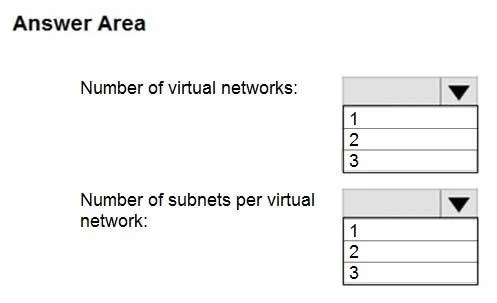
Answer Area
- Number of virtual networks:123
- Number of subnets per virtual network:123
Explanation
To effectively segment and secure a three-tier application in Azure, a single virtual network should be used, with each application tier placed into its own dedicated subnet.
Approach. The correct interaction is to select '1' for 'Number of virtual networks' and '3' for 'Number of subnets per virtual network'.
Number of virtual networks: 1 Contoso's App1 is described as a single application with three tiers that need to communicate. For a single application deployment, the best practice in Azure is to contain all its tiers within a single Azure Virtual Network (VNet). This simplifies network architecture, routing, and management, and avoids the complexity and potential latency/cost of VNet peering that would be required if multiple VNets were used for a single application.
Number of subnets per virtual network: 3 App1 consists of three distinct tiers: a SQL database, a web front end, and a processing middle tier. The technical requirement is to 'Minimize the number of open ports between the App1 tiers'. To achieve granular network security and control traffic flow between these tiers effectively (e.g., using Network Security Groups - NSGs), each tier should be placed in its own dedicated subnet. This allows for specific inbound and outbound rules to be applied to each subnet, ensuring that only necessary communication paths (i.e., minimal open ports) exist between the Web, Middle, and Database tiers.
Common mistakes.
- common_mistake. 1. Choosing multiple virtual networks (2 or 3): While technically possible to separate tiers into different VNets and connect them via VNet peering, this adds unnecessary complexity, management overhead, and potential costs for a single application. It doesn't align with simplifying the infrastructure for a unified application deployment unless there are strong reasons for complete network isolation (e.g., different administrative domains, compliance boundaries, separate subscription ownership), which are not indicated here.
- Choosing 1 subnet: Placing all three tiers into a single subnet would make it extremely difficult to 'Minimize the number of open ports between the App1 tiers' using subnet-level Network Security Groups (NSGs). NSGs primarily filter traffic between subnets or into/out of a VNet. Within the same subnet, traffic between VMs would not be filtered by NSG rules applied to the subnet itself, thus compromising the security segmentation requirement.
- Choosing 2 subnets: This choice would force at least two of the application's three distinct tiers into the same subnet, violating the principle of isolating each tier for optimal security, manageability, and traffic control. This would make it harder to apply fine-grained security policies between those specific tiers.
Concept tested. Azure Virtual Network (VNet) design, subnetting best practices for multi-tier applications, network segmentation for security (implied NSG usage), and meeting application-specific networking requirements in Azure.
Reference. null
Topics
Community Discussion
No community discussion yet for this question.