
AD0-E409 · Question #110
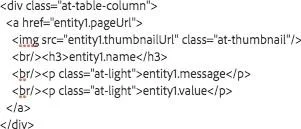
A Target developer is testing a new recommendations design but is observing an issue where the dynamic product information is not being replaced in the html code. Based on the code snippet below of…
The correct answer is A. Append "$" to the front of all of the entity references. In Adobe Target Recommendations, designs are built using Velocity Template Language (VTL), which requires the $ symbol to denote variable/entity references (e.g., $entity1.name, $entity1.thumbnailUrl). Without the $ prefix, Target treats the reference as plain text and never…
Question
A Target developer is testing a new recommendations design but is observing an issue where the dynamic product information is not being replaced in the html code. Based on the code snippet below of the Recommendations design, what should the architect recommend the developer do to resolve the issue?
Exhibit
Options
- AAppend "$" to the front of all of the entity references.
- BAppend "jQuery" to the front of all of the entity references.
- CAppend "#" to the front of all of the entity references.
- DUse "&" instead of "$" for entity references.
How the community answered
(34 responses)- A85% (29)
- B3% (1)
- C3% (1)
- D9% (3)
Explanation
In Adobe Target Recommendations, designs are built using Velocity Template Language (VTL), which requires the $ symbol to denote variable/entity references (e.g., $entity1.name, $entity1.thumbnailUrl). Without the $ prefix, Target treats the reference as plain text and never substitutes it with dynamic product data - which is exactly the issue the developer is observing.
Why the distractors are wrong:
- B (jQuery): jQuery is a JavaScript library with no role in VTL template rendering; prefixing with "jQuery" would produce invalid syntax.
- C (#): In VTL,
#is reserved for directives (e.g.,#foreach,#if), not variable references - using it here would cause a parsing error, not a substitution. - D (&):
&is an HTML entity escape character (e.g.,&), unrelated to VTL variable syntax entirely.
Memory tip: Think of $ as the standard "variable sigil" - just like $variable in PHP or shell scripting. In Velocity/Target designs, if you want dynamic data, you need the dollar sign.
Topics
Community Discussion
No community discussion yet for this question.