
700-280 · Question #6
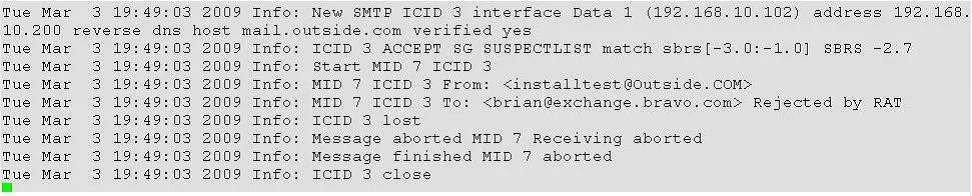
Refer to the exhibit. You have finished installing a C-160 that is designed to filter incoming and relay outgoing mail for the mail server exchange.bravo.com. This is a one armed installation. The…
The correct answer is D. Exchange.bravo.com needs to be configured in the RAT. Option D is correct because the Recipient Access Table (RAT) is what tells the C-160's public listener which recipient domains it is authorized to accept inbound mail for. Without exchange.bravo.com listed in the RAT, the appliance will reject all incoming SMTP connections…
Question
Refer to the exhibit. You have finished installing a C-160 that is designed to filter incoming and relay outgoing mail for the mail server exchange.bravo.com. This is a one armed installation. The incoming mail cannot be received from any source on the internet. According to the mail log, what is the most likely problem?
Exhibit
Options
- AThe mail server needs to point to a private listener instead of a public listener.
- BExchange.bravo.com needs to be configured on the RELAYLIST
- CAn SMTP route needs to be configured for exchange.bravo.com
- DExchange.bravo.com needs to be configured in the RAT
- EExchange.bravo.com needs to be removed from the SUSPECTLIST
How the community answered
(45 responses)- A7% (3)
- B13% (6)
- C2% (1)
- D78% (35)
Explanation
Option D is correct because the Recipient Access Table (RAT) is what tells the C-160's public listener which recipient domains it is authorized to accept inbound mail for. Without exchange.bravo.com listed in the RAT, the appliance will reject all incoming SMTP connections destined for that domain - exactly matching the symptom described. This is the gatekeeping step that happens before any content filtering or routing logic runs.
Why the distractors are wrong:
- A is backwards - private listeners handle outgoing relay from internal hosts, not inbound internet mail; the public listener is already the right choice for incoming mail.
- B (RELAYLIST) controls which senders are permitted to relay outbound mail through the appliance - it has no bearing on whether inbound mail is accepted.
- C (SMTP route) tells the appliance where to deliver accepted mail internally; it affects delivery after acceptance, not whether the domain is accepted at all.
- E (SUSPECTLIST) is not a standard IronPort construct for recipient filtering, making this a pure distractor.
Memory tip: Think of the RAT as the "guest list at the door" - if your domain isn't on it, the bouncer (public listener) turns away all mail before it ever gets inside, regardless of what routing or filtering rules exist downstream.
Topics
Community Discussion
No community discussion yet for this question.