
70-698 · Question #25
Note: This question is part of a series of questions that use the same scenario. For your convenience, the scenario is repeated in each question. Each question presents a different goal and answer…
The correct answer is B. Credential Manager. Credential Manager is the Windows feature used to persistently store and reuse credentials for network resources without repeated interactive prompts.
Question
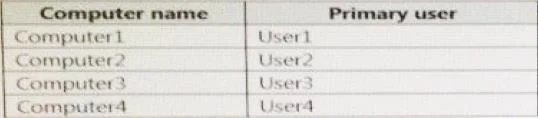
Note: This question is part of a series of questions that use the same scenario. For your convenience, the scenario is repeated in each question. Each question presents a different goal and answer choices, but the text of the scenario is exactly the same in each question in this series. Start of repeated scenario Your network contains a single Active Directory domain named adatum.com. The network contains five servers configured as shown in the following table. All of the servers run Windows Server 2012 R2. Test_Server has a shared folder named ShareA. Only local users have permissions to ShareA. The network contains a mainframe computer that is administered by using the Telnet protocol. The domain contains four client computers configured as shown in the following table. All of the client computers run the 64-bit version of Windows. User3 frequently accesses ShareA. Remote Desktop is enabled on Computer4. Your company identifies the following requirements:
- Ensure that you can test unsigned device drivers on Computer1
- Enable Credential Guard on Computer2.
- Run commands and cmdlets remotely on computer2.
- Configure User Account control (UAC) on Computer3 to prompt
administrators for credentials when elevated privileges are required.
- Ensure that User1 can view and interact with a desktop session of
User3.
- Ensure that User2 can use Telnet to manage the mainframe.
- Ensure that User4 can use Remote Desktop to access Computer4
remotely. End of repeated scenario. On Test_Server, you reset the password for User3. You need to ensure that User3 can access ShareA. Which tool should you instruct User3 to use on Computer3?
Exhibits

Options
- Athe Get-Credential cmdlet
- BCredential Manager
- CAuthorization Manager
- DActive Directory Users and Computers
How the community answered
(39 responses)- A3% (1)
- B92% (36)
- D5% (2)
Why each option
Credential Manager is the Windows feature used to persistently store and reuse credentials for network resources without repeated interactive prompts.
Get-Credential is a PowerShell cmdlet that prompts the user interactively for credentials at runtime and does not store or persist them for future connections.
Credential Manager (accessible via Control Panel) allows users to save Windows credentials - username and password pairs - for specific network addresses or resources such as file shares or remote systems. Once stored, Windows automatically provides these credentials when connecting to the matching resource, enabling seamless access without repeated prompts. This makes it the correct tool for storing credentials used to access resources like ShareA or a Telnet-administered mainframe.
Authorization Manager (AzMan) is a role-based access control framework for developers to manage application permissions, not a tool for storing user authentication credentials.
Active Directory Users and Computers is a domain management tool for user accounts and group memberships and cannot store or manage local credential entries for resource access.
Concept tested: Storing network credentials persistently using Credential Manager
Source: https://learn.microsoft.com/en-us/windows/security/threat-protection/windows-credential-manager
Topics
Community Discussion
No community discussion yet for this question.