
70-698 · Question #24
Note: This question is part of a series of questions that use the same scenario. For your convenience, the scenario is repeated in each question. Each question presents a different goal and answer…
The correct answer is C. Security Options in the Computer Configuration of the Local Computer Policy. Security Options under Computer Configuration in Local Computer Policy is the correct location to configure machine-wide security behaviors such as network authentication models.
Question
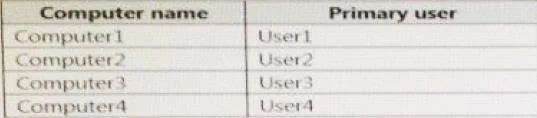
Note: This question is part of a series of questions that use the same scenario. For your convenience, the scenario is repeated in each question. Each question presents a different goal and answer choices, but the text of the scenario is exactly the same in each question in this series. Start of repeated scenario Your network contains a single Active Directory domain named adatum.com. The network contains five servers configured as shown in the following table. All of the servers run Windows Server 2012 R2. Test_Server has a shared folder named ShareA. Only local users have permissions to ShareA. The network contains a mainframe computer that is administered by using the Telnet protocol. The domain contains four client computers configured as shown in the following table. All of the client computers run the 64-bit version of Windows. User3 frequently accesses ShareA. Remote Desktop is enabled on Computer4. Your company identifies the following requirements:
- Ensure that you can test unsigned device drivers on Computer1
- Enable Credential Guard on Computer2.
- Run commands and cmdlets remotely on computer2.
- Configure User Account control (UAC) on Computer3 to prompt
administrators for credentials when elevated privileges are required.
- Ensure that User1 can view and interact with a desktop session of
User3.
- Ensure that User2 can use Telnet to manage the mainframe.
- Ensure that User4 can use Remote Desktop to access Computer4
remotely. End of repeated scenario. You need to configure Computer3 to meet the UAC requirement. What should you use?
Exhibits

Options
- AUser Account Control Settings
- BCredential Manager
- CSecurity Options in the Computer Configuration of the Local Computer Policy.
- DSecurity Settings in the User Computer of the Local Computer Policy.
How the community answered
(29 responses)- A7% (2)
- B3% (1)
- C83% (24)
- D7% (2)
Why each option
Security Options under Computer Configuration in Local Computer Policy is the correct location to configure machine-wide security behaviors such as network authentication models.
User Account Control Settings only adjusts the UAC notification level and does not provide policy-level control over network access or credential behavior for local accounts.
Credential Manager stores saved credentials for specific resources and cannot be used to configure system-wide security policy behavior.
The Security Options node at Computer Configuration > Windows Settings > Security Settings > Local Policies > Security Options contains policy settings that govern system-wide security behaviors, including network access models and how local accounts are treated on the network. This is the authoritative location for settings like 'Network access: Sharing and security model for local accounts,' which controls whether local accounts authenticate as themselves or as Guest.
Security Settings under User Configuration apply per-user and are not the correct node for machine-wide security option configurations that affect all users.
Concept tested: Local Security Policy - Security Options for network access
Source: https://learn.microsoft.com/en-us/windows/security/threat-protection/security-policy-settings/security-options
Topics
Community Discussion
No community discussion yet for this question.