
70-663 · Question #207
Your network contains an Active Directory forest named contoso.com and two Active Directory sites named Site1 and Site2. You plan to deploy an Exchange Server 2010 Service Pack 1 (SP1) organization…
The correct answer is C. shadow redundancy. High availability strategies for Exchange have focused on the availability and recoverability of data stored in mailbox databases. When you implement a highly available solution for your Mailbox servers, the e-mail messages won't be lost, and they can easily be recovered after…
Question
Your network contains an Active Directory forest named contoso.com and two Active Directory sites named Site1 and Site2. You plan to deploy an Exchange Server 2010 Service Pack 1 (SP1) organization. An independent consultant recommends a design for the Exchange Server 2010 SP1 deployment as shown in the following table. You are evaluating the implementation of the Hub Transport server role on EX4. You need to identify which Exchange server configuration will minimize the loss of email messages sent between users of the organization if a Hub Transport server fails. What should you identify?
Exhibit
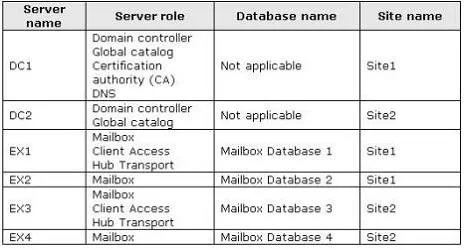
Options
- ADNS round robin on DC1 and DC2
- BDatacenter Activation Coordination (DAC) mode
- Cshadow redundancy
- Ddelayed acknowledgments (ACKs)
- Ea Hosts file on EX1, EX2, EX3, and EX4
- Fa database availability group (DAG)
- Ga single copy cluster (SCC)
- Han activation preference for a database
- Ja DNS server on DC2
How the community answered
(42 responses)- A10% (4)
- C81% (34)
- D2% (1)
- E2% (1)
- G5% (2)
Explanation
High availability strategies for Exchange have focused on the availability and recoverability of data stored in mailbox databases. When you implement a highly available solution for your Mailbox servers, the e-mail messages won't be lost, and they can easily be recovered after a failure, after they arrive in a mailbox. However, these strategies didn't extend to messages while they're in transit. If a Hub Transport server fails while processing messages and can't be recovered, data loss could occur. As the volume of messages processed by Hub Transport servers increases, potential data loss becomes an increasing concern for administrators. Microsoft Exchange Server 2007 introduced the transport dumpster feature for the Hub Transport An Exchange 2007 Hub Transport server maintains a queue of messages delivered recently to recipients whose mailboxes are on a clustered mailbox server. When a failover is experienced, the clustered mailbox server automatically requests every Hub Transport server in the Active Directory site to resubmit mail from the transport dumpster queue. This prevents mail from being lost during the time taken for the cluster to fail over. While this does provide a basic level of transport redundancy, it's only available for message delivery in a cluster continuous replication (CCR) environment and doesn't address potential message loss when messages are in transit between Hub Transport and Edge Transport servers. Exchange Server 2010 introduces the shadow redundancy feature to provide redundancy for messages for the entire time they're in transit. The solution involves a technique similar to the transport dumpster. With shadow redundancy, the deletion of a message from the transport databases is delayed until the transport server verifies that all of the next hops for that message have completed delivery. If any of the next hops fail before reporting back successful delivery, the message is resubmitted for delivery to that next hop. Shadow redundancy provides the following benefits: - It eliminates the reliance on the state of any specific Hub Transport or Edge Transport server. As long as redundant message paths exist in your routing topology, any transport server becomes disposable. - If a transport server fails, you can remove it from production without emptying its queues or losing messages. - If you want to upgrade a Hub Transport or Edge Transport server, you can bring that server offline at any time without the risk of losing - It eliminates the need for storage hardware redundancy for transport - It consumes less bandwidth than creating duplicate copies of messages on multiple servers. The only additional network traffic generated with shadow redundancy is the exchange of discard status between transport servers. Discard status is the information each transport server maintains. It indicates when a message is ready to be discarded from the transport database. - It provides resilience and simplifies recovery from a transport
Topics
Community Discussion
No community discussion yet for this question.