
70-467 · Question #42
You are defining a named set by using Multidimensional Expressions (MDX) in a sales cube. The cube includes a Customer dimension that contains a Geography hierarchy and a Gender attribute hierarchy…
The correct answer is A. Option A. MDX named sets filter dimension members by combining a hierarchy set with an attribute constraint using functions like EXISTS or FILTER to scope results correctly.
Question
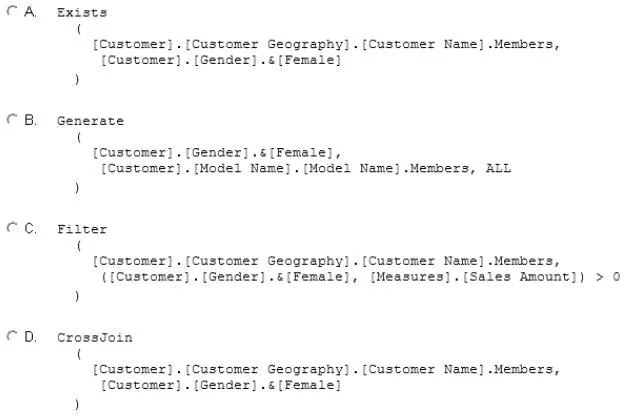
You are defining a named set by using Multidimensional Expressions (MDX) in a sales cube. The cube includes a Customer dimension that contains a Geography hierarchy and a Gender attribute hierarchy. You need to return only the female customers in the Geography hierarchy. Which set should you use? (More than one answer choice may achieve the goal. Select the BEST answer.)
Exhibit
Options
- AOption A
- BOption B
- COption C
- DOption D
How the community answered
(45 responses)- A73% (33)
- B16% (7)
- C9% (4)
- D2% (1)
Why each option
MDX named sets filter dimension members by combining a hierarchy set with an attribute constraint using functions like EXISTS or FILTER to scope results correctly.
Option A correctly uses an MDX set expression such as EXISTS or FILTER to return only members of the Geography hierarchy that correspond to female customers, by intersecting Geography hierarchy members with the [Customer].[Gender].[Female] attribute member. This approach properly scopes the result to the Geography hierarchy while applying the gender constraint, which is the precise behavior required for the named set.
Option B likely returns all Geography hierarchy members without correctly applying the female gender filter, producing an inaccurate or unfiltered set.
Option C likely uses an incorrect MDX syntax or function that fails to properly cross-reference the Gender attribute with the Geography hierarchy members.
Option D likely uses CROSSJOIN or a similar expression that returns a tuple set combining both hierarchies rather than filtering Geography members by the female gender attribute.
Concept tested: MDX named set filtering with attribute hierarchies
Source: https://learn.microsoft.com/en-us/analysis-services/multidimensional-models/mdx/building-named-sets-in-mdx-multidimensional
Topics
Community Discussion
No community discussion yet for this question.