
70-467 · Question #41
You are creating a Multidimensional Expressions (MDX) calculation for Projected Revenue in a cube. For Product A, Projected Revenue is defined as 150 percent of the Total Sales of the product. For…
The correct answer is C. Option C. The most efficient MDX Projected Revenue calculation uses a single conditional expression (IIF or CASE) that applies 1.5x for Product A and 1.1x for all other products within one calculated member definition.
Question
You are creating a Multidimensional Expressions (MDX) calculation for Projected Revenue in a cube. For Product A, Projected Revenue is defined as 150 percent of the Total Sales of the product. For all other products, Projected Revenue is defined as 110 percent of the Total Sales of the product. You need to calculate the Projected Revenue as efficiently as possible. Which calculation should you use? (More than one answer choice may achieve the goal. Select the BEST answer.)
Exhibit
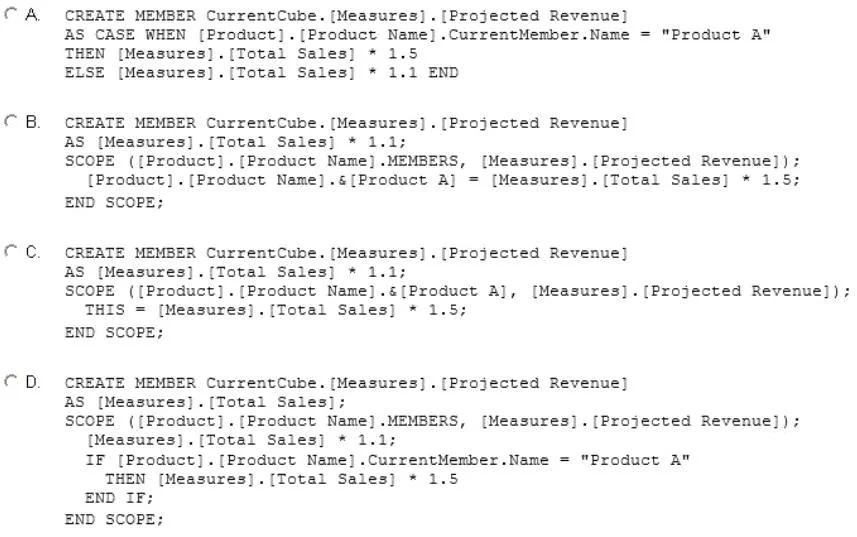
Options
- AOption A
- BOption B
- COption C
- DOption D
How the community answered
(28 responses)- A4% (1)
- B11% (3)
- C82% (23)
- D4% (1)
Why each option
The most efficient MDX Projected Revenue calculation uses a single conditional expression (IIF or CASE) that applies 1.5x for Product A and 1.1x for all other products within one calculated member definition.
Option A likely applies an incorrect multiplier or reverses the condition, assigning 110% to Product A and 150% to all others, producing mathematically wrong Projected Revenue values.
Option B likely uses a less efficient MDX structure such as separate calculated members or redundant SCOPE assignments that achieve the same result but with unnecessary computational overhead.
Option C most likely uses an IIF function or equivalent conditional MDX syntax that evaluates the current product member in a single expression and returns the correct multiplier without redundant passes over the data. This pattern is optimal because the condition is resolved once per cell during calculation, and it reuses the existing Total Sales measure value without materializing intermediate results. Encapsulating the entire logic in one calculated member avoids the overhead of multiple SCOPE statements or nested calculated members that other options may introduce.
Option D likely uses an overly complex or verbose MDX expression that evaluates the product condition inefficiently, such as iterating over a set rather than testing the current member directly.
Concept tested: Conditional MDX calculated member for product-specific projection
Source: https://learn.microsoft.com/en-us/analysis-services/multidimensional-models/mdx/building-calculated-members-in-mdx
Topics
Community Discussion
No community discussion yet for this question.