
70-465 · Question #131
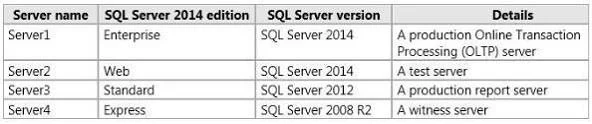
You have a SQL Server 2014 environment That includes four servers. The servers are configured as shown in the following table. You plan to configure Policy-Based Management to enforce the following…
The correct answer is A. Server1 C. Server3. The question asks which servers can serve as a Central Management Server (CMS) for Policy-Based Management, given that policies must be enforced on Server1 and Server3 with specific rules involving on-demand evaluation modes.
Question
Exhibit
Options
- AServer1
- BServer2
- CServer3
- DSeiver4
How the community answered
(24 responses)- A88% (21)
- B4% (1)
- D8% (2)
Why each option
The question asks which servers can serve as a Central Management Server (CMS) for Policy-Based Management, given that policies must be enforced on Server1 and Server3 with specific rules involving on-demand evaluation modes.
Server1 can be configured as a Central Management Server because a CMS can manage policies for itself and other registered servers. The policies for Server1 (password policies and default trace) and Server3 (stored procedure naming and collation) can all be evaluated on demand or on schedule from Server1.
Server2 is running SQL Server 2008 R2, which does not support all the Policy-Based Management features needed to serve as a Central Management Server for evaluating policies against SQL Server 2014 instances in this scenario.
Server3 can also serve as the Central Management Server, as it can register and evaluate policies against both itself and Server1. The policies specified (naming conventions, collation checks, password policies, default trace) use on-demand or on-schedule evaluation modes that work across registered servers via a CMS.
Server4 is running SQL Server 2008, which is an older version that lacks full Central Management Server capabilities required to evaluate and enforce Policy-Based Management policies against the SQL Server 2014 instances in this environment.
Concept tested: Central Management Server and Policy-Based Management in SQL Server
Source: https://learn.microsoft.com/en-us/sql/relational-databases/policy-based-management/administer-servers-by-using-policy-based-management
Topics
Community Discussion
No community discussion yet for this question.