70-459 · Question #71
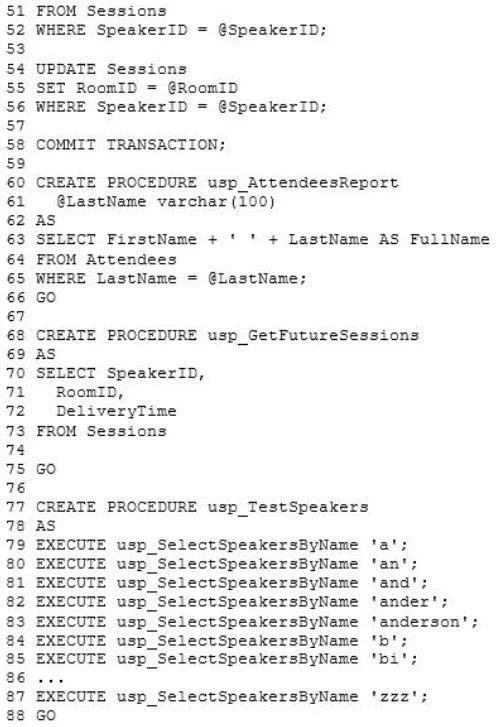
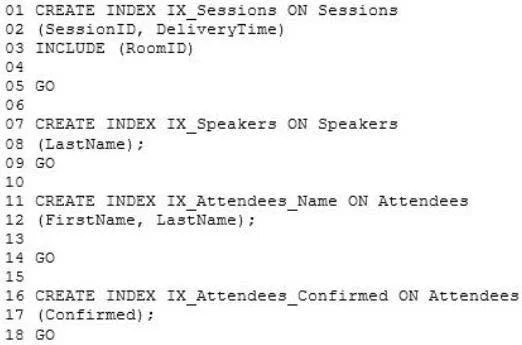
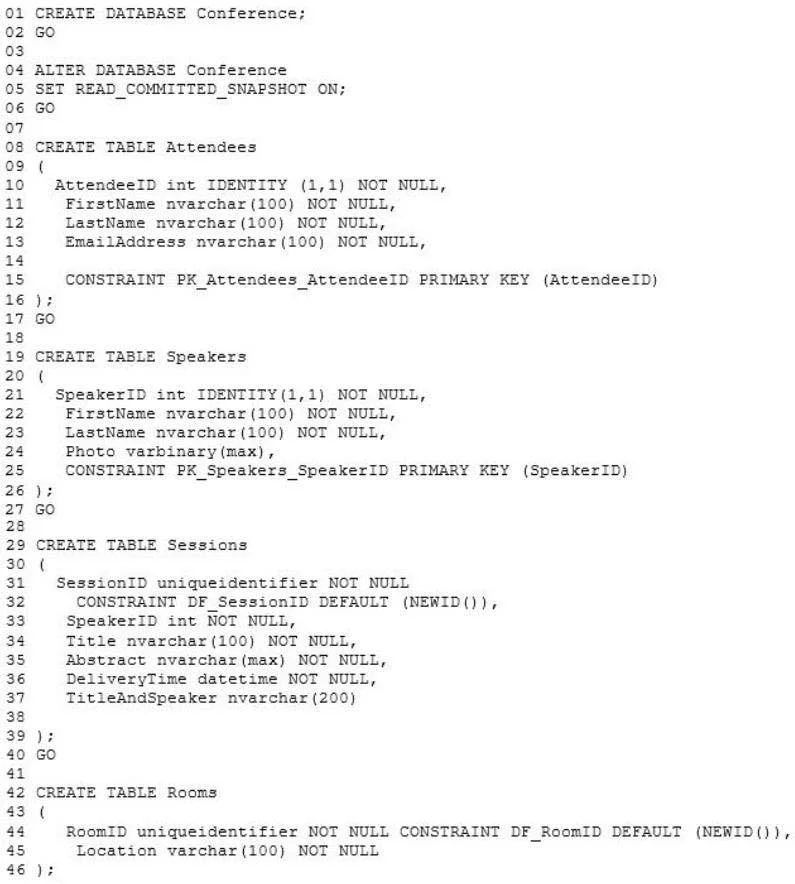
You need to modify usp_SelectSpeakersByName to support server-side paging. The solution must minimize the amount of development effort required. What should you add to usp_SelectSpeakersByName?
The correct answer is B. an OFFSET-FETCH clause. Case Study 7 - Invoice Scehma Scenario (QUESTION 72 ~ QUESTION 78) Application Information Your company receives invoices in XML format from customers. Currently, the invoices are stored as files and processed by a desktop application. The application has several performance and
Question
Exhibits
Options
- Aa table variable
- Ban OFFSET-FETCH clause
- Cthe ROWNUMBER keyword
- Da recursive common table expression
How the community answered
(23 responses)- A13% (3)
- B78% (18)
- C4% (1)
- D4% (1)
Explanation
Case Study 7 - Invoice Scehma Scenario (QUESTION 72 ~ QUESTION 78) Application Information Your company receives invoices in XML format from customers. Currently, the invoices are stored as files and processed by a desktop application. The application has several performance and security issues. The application is being migrated to a SQL Server-based solution. A schema named InvoiceSchema has been created for the invoices xml. The data in the invoices is sometimes incomplete. The incomplete data must be stored and processed as-is. Users cannot filter the data provided through views. You are designing a SQL Server database named DB1 that will be used to receive, process, and securely store the invoice data. A third-party Microsoft .NET Framework component will be purchased to perform tax calculations. The third-party tax component will be provided as a DLL file named Treytax.dll and a source code file named Amortize.cs. The component will expose a class named TreyResearch and a method named Amortize(). The files are located in c:\temp. The following graphic shows the planned tables: You have a sequence named Accounting.InvoiceID_Seq. You plan to create two certificates named CERT1 and CERT2. You will create CERT1 in master. You will create CERT2 in DB1. You have a legacy application that requires the ability to generate dynamic T-SQL statements A sample of the queries generated by the legacy application appears in Legacy.sql. Application Requirements The planned database has the following requirements: - All stored procedures must be signed. - The original XML invoices must be stored in the database. - An XML schema must be used to validate the invoice data. - Dynamic T-SQL statements must be converted to stored procedures. - Access to the .NET Framework tax components must be available to T- - Columns must be defined by using data types that minimize the amount of space used by each table. - Invoices stored in the InvoiceStatus table must refer to an invoice by the same identifier used by the Invoice table. - To protect against the theft of backup disks, invoice data must be protected by using the highest level of encryption. - The solution must provide a table-valued function that provides users with the ability to filter invoices by customer. - Indexes must be optimized periodically based on their fragmentation by using the minimum amount of administrative effort. Usp_InsertInvoices.sql All customer IDs are 11 digits. The first three digits of a customer ID represent the customer's country. The remaining eight digits are the customer's account number. The following is a sample of a customer invoice in XML format: InvoicesByCustomer.sql CountryFromID.sql IndexManagement.sql
Topics
Community Discussion
No community discussion yet for this question.