
500-220 · Question #14
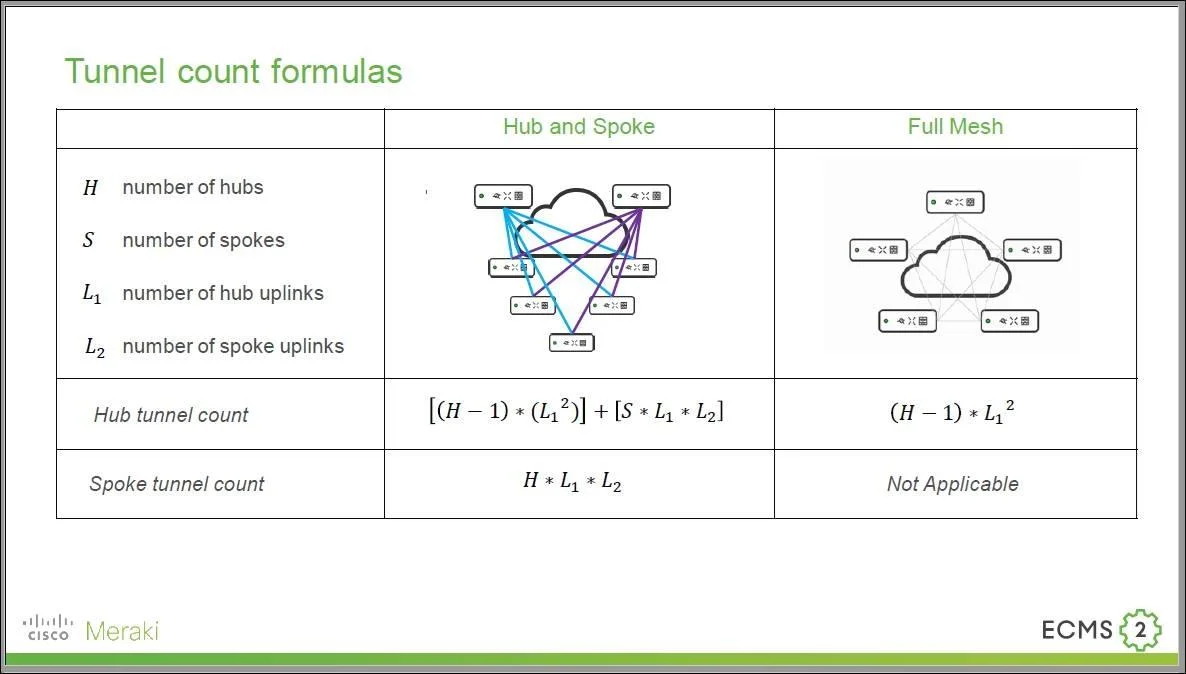
A customer requires a hub-and-spoke Auto VPN deployment with two NAT-mode hubs with dual uplink connections and 50 remote sites with a single uplink connection. How many tunnels does each hub need…
The correct answer is D. 104. Option D (104) is correct because each hub must account for two types of tunnel connections, and uplinks multiply the tunnel count. Each hub has 2 uplinks connecting to 50 spokes with 1 uplink each, generating 2 × 50 = 100 spoke tunnels (one tunnel per hub uplink, per spoke)…
Question
A customer requires a hub-and-spoke Auto VPN deployment with two NAT-mode hubs with dual uplink connections and 50 remote sites with a single uplink connection. How many tunnels does each hub need to support?
Exhibit
Options
- A52
- B54
- C100
- D104
How the community answered
(45 responses)- A11% (5)
- B7% (3)
- C2% (1)
- D80% (36)
Explanation
Option D (104) is correct because each hub must account for two types of tunnel connections, and uplinks multiply the tunnel count. Each hub has 2 uplinks connecting to 50 spokes with 1 uplink each, generating 2 × 50 = 100 spoke tunnels (one tunnel per hub uplink, per spoke). Additionally, the two hubs must form tunnels with each other: 2 uplinks × 2 uplinks = 4 hub-to-hub tunnels, giving 100 + 4 = 104 total.
Why the distractors fail:
- A (52): Counts 50 spokes × 1 tunnel + 2 hub-to-hub - ignores that dual uplinks on the hub double the spoke tunnels.
- B (54): Counts 50 spokes × 1 tunnel + 4 hub-to-hub - still ignores uplink multiplication on spoke tunnels.
- C (100): Correctly multiplies hub uplinks × spokes (2 × 50), but forgets the 4 hub-to-hub tunnels entirely.
Memory tip: Use the formula (Hub uplinks × Spokes) + (Hub uplinks × Hub uplinks) = (2 × 50) + (2 × 2) = 104. Think of it as "uplinks multiply everything" - both spoke connections and hub-to-hub peering scale with the number of uplinks on each side.
Topics
Community Discussion
No community discussion yet for this question.