
4A0-107 · Question #28
Click the exhibit button below. Given the slope-policy (below), which of the following statements are TRUE? (Choose two)
The correct answer is C. When the shared buffer utilization reaches 55%, both in-profile and out-of-profile packets may be D. The maximum probability with which an out-of-profile packet can be dropped is higher than that of. Slope Policy QoS Buffer Management Options C and D are correct because slope policies use probabilistic dropping (similar to WRED) rather than absolute cutoffs. At 55% shared buffer utilization, both the in-profile and out-of-profile drop slopes have typically crossed their…
Question
Click the exhibit button below. Given the slope-policy (below), which of the following statements are TRUE? (Choose two)
Exhibit
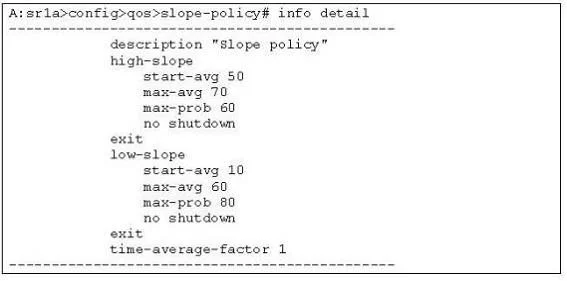
Options
- AAll out-of-profile traffic will be dropped before that of any in-profile traffic.
- BThe discard probability slope of an in-profile traffic is steeper than that of an out-of- profile traffic.
- CWhen the shared buffer utilization reaches 55%, both in-profile and out-of-profile packets may be
- DThe maximum probability with which an out-of-profile packet can be dropped is higher than that of
- EWhen the shared buffer utilization is at 61%, only in-profile packets are currently in the shared
How the community answered
(39 responses)- A8% (3)
- B13% (5)
- C74% (29)
- E5% (2)
Explanation
Slope Policy QoS Buffer Management
Options C and D are correct because slope policies use probabilistic dropping (similar to WRED) rather than absolute cutoffs. At 55% shared buffer utilization, both the in-profile and out-of-profile drop slopes have typically crossed their respective low-threshold trigger points, meaning packets from both traffic classes are subject to random early discard - hence "may be" dropped (C is true). Additionally, the out-of-profile slope is deliberately designed to reach a higher maximum drop probability (often 100%) than in-profile traffic (often ~75–80%), ensuring conforming traffic is preferentially protected over excess traffic (D is true).
Why the distractors are wrong:
- A is false because dropping is probabilistic, not sequential - you won't exhaust all out-of-profile packets before touching in-profile ones; both slopes operate concurrently.
- B is false because the out-of-profile slope is steeper, not the in-profile one - it rises faster to push excess traffic out more aggressively.
- E is false because high drop probability doesn't mean zero out-of-profile packets remain in the buffer; some still get through probabilistically until 100% drop is reached.
Memory tip: Think of slope policy as a "two-lane ramp" - the out-of-profile lane hits a tollbooth (drop) earlier and harder than the in-profile lane, but both lanes can have cars on them at the same time. "Higher max drop + earlier trigger = punish the overage, protect the contract."
Topics
Community Discussion
No community discussion yet for this question.