
4A0-107 · Question #77
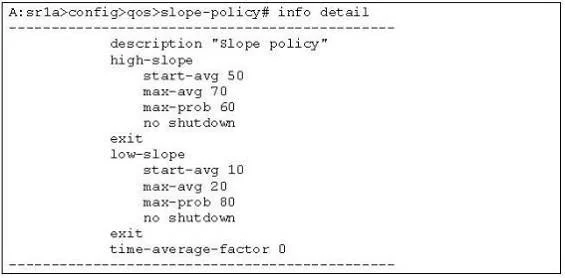
Click the exhibit button below. Given that the slope-policy (below) has been enabled and applied on a network port, which of the following statements are TRUE? (Choose three)
The correct answer is A. All out-of-profile traffic will be dropped before any in-profile is dropped. C. When the shared buffer utilization reaches 51%, in-profile packets might be dropped. E. When an in-profile packet arrives and the shared buffer utilization is at 69%, the packet will have. Why A, C, and E are correct: A is correct because slope policies are designed so the out-of-profile (red) curve reaches 100% drop probability at a buffer fill level where the in-profile (green) curve hasn't yet started dropping. This guarantees out-of-profile traffic is fully…
Question
Click the exhibit button below. Given that the slope-policy (below) has been enabled and applied on a network port, which of the following statements are TRUE? (Choose three)
Exhibit
Options
- AAll out-of-profile traffic will be dropped before any in-profile is dropped.
- BThe time average factor of 0 will discard all packets arriving in the shared buffer pool.
- CWhen the shared buffer utilization reaches 51%, in-profile packets might be dropped.
- DThe highest probability with which an out-of-profile packet can be dropped is 20%.
- EWhen an in-profile packet arrives and the shared buffer utilization is at 69%, the packet will have
How the community answered
(61 responses)- A66% (40)
- B11% (7)
- D23% (14)
Explanation
Why A, C, and E are correct:
A is correct because slope policies are designed so the out-of-profile (red) curve reaches 100% drop probability at a buffer fill level where the in-profile (green) curve hasn't yet started dropping. This guarantees out-of-profile traffic is fully purged before any in-profile packet is touched - a core guarantee of WRED/slope-based QoS.
C is correct because the exhibit shows the in-profile slope begins at approximately 50% shared buffer utilization. At 51%, you've crossed the low threshold of the in-profile curve, meaning probabilistic dropping can begin (note "might" - it's not certain yet, just possible at low probability).
E is correct because at 69% buffer utilization, the in-profile traffic is well into its drop slope (between the low and high thresholds), so arriving in-profile packets face a meaningful - and deterministic based on the curve - drop probability per the policy's configured slope.
Why B and D are wrong:
- B is wrong - A time average factor (TAF) of 0 means no exponential smoothing of the queue depth average (instantaneous measurement only); it does not cause all packets to be discarded.
- D is wrong - Out-of-profile packets can be dropped with up to 100% probability once buffer utilization hits the out-of-profile high threshold. The 20% value likely refers to the starting drop probability at the low threshold, not the maximum.
Memory tip: Think of it as a two-lane highway closing in a storm - the "out-of-profile" (secondary) lane closes completely before the "in-profile" (priority) lane is touched at all.
Topics
Community Discussion
No community discussion yet for this question.