
352-011 · Question #12
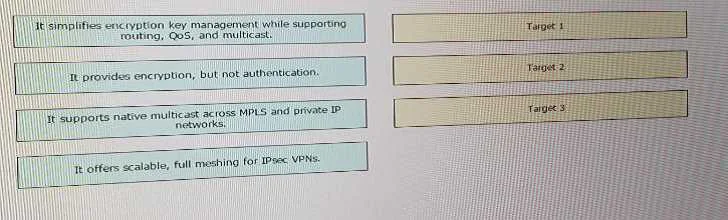
DRAG DROP Drag and drop the design characteristics of GET VPN from the left to the right. Not all options are used. Answer: A, C, D
The correct answer is It simplifies encryption key management while supporting routing, QoS, and multicast.; It supports native multicast across MPLS and private IP networks.; It offers scalable, full meshing for IPsec VPNs. GET VPN Design Characteristics - Explanation What is GET VPN? GET VPN (Group Encrypted Transport VPN) is a Cisco tunnel-less encryption technology designed for use over trusted networks like MPLS or private WANs. It uses a centralized Key Server (KS) to distribute shared keys…
Question
DRAG DROP Drag and drop the design characteristics of GET VPN from the left to the right. Not all options are used. Answer:
A, C, D
Exhibit
Answer Area
Drag items
Correct arrangement
- It simplifies encryption key management while supporting routing, QoS, and multicast.
- It supports native multicast across MPLS and private IP networks.
- It offers scalable, full meshing for IPsec VPNs.
Explanation
GET VPN Design Characteristics - Explanation
What is GET VPN?
GET VPN (Group Encrypted Transport VPN) is a Cisco tunnel-less encryption technology designed for use over trusted networks like MPLS or private WANs. It uses a centralized Key Server (KS) to distribute shared keys to Group Members (GMs), and crucially, it preserves the original IP header rather than encapsulating it in a new tunnel header.
Why Each Item Is Placed (or Excluded)
Position 1 - Item A: "It simplifies encryption key management while supporting routing, QoS, and multicast."
Why it's correct:
- GET VPN uses GDOI (Group Domain of Interpretation) with a centralized Key Server that pushes IPsec keys to all group members. You don't manually configure pairwise tunnels - one KS manages keys for the entire group. This is the core management simplification.
- Because GET VPN uses header preservation (the original source/destination IP headers are untouched), the underlying network still sees the real IP addresses. This means routing protocols, QoS DSCP markings, and multicast all work natively - they aren't broken by encapsulation.
Position 2 - Item C: "It supports native multicast across MPLS and private IP networks."
Why it's correct:
- Traditional IPsec encapsulates the entire original packet inside a new IP header, which destroys multicast because multicast destination addresses (224.x.x.x) can't survive encapsulation.
- GET VPN's tunnel-less, header-preserving design means the original multicast destination IP is visible to the network. Multicast replication works naturally over the MPLS/private WAN fabric.
This is a key differentiator from DMVPN or traditional site-to-site IPsec, which require GRE tunnels to carry multicast.
Position 3 - Item D: "It offers scalable, full meshing for IPsec VPNs."
Why it's correct:
- Traditional IPsec requires
n*(n-1)/2tunnels for full mesh (e.g., 100 sites = 4,950 tunnels). GET VPN uses a group Security Association (SA) - all members share the same encryption keys, so any member can decrypt traffic from any other member without a dedicated tunnel. Full mesh connectivity is automatic and scales linearly (just register new GMs with the KS).
Excluded - Item B: "It provides encryption, but not authentication."
Why it's wrong (common misconception):
- GET VPN uses IPsec ESP, which provides both encryption and data-origin authentication/integrity. The claim that GET VPN lacks authentication is false.
- The confusion sometimes arises because GET VPN trusts the underlying network (MPLS/private WAN) for perimeter security and doesn't use public-key infrastructure for peer authentication the same way traditional IPsec IKE does - but the actual traffic is still authenticated via IPsec ESP's integrity check (e.g., HMAC-SHA).
Summary Table
| Item | Included? | Core Reason |
|---|---|---|
| A | Yes | Centralized key server + header preservation enables routing/QoS/multicast |
| B | No | GET VPN provides both encryption and authentication |
| C | Yes | Header preservation enables native multicast over MPLS/private WAN |
| D | Yes | Group SA model = full mesh without per-tunnel configuration |
Common Exam Mistakes
- Confusing GET VPN with DMVPN - DMVPN is also scalable but uses GRE tunnels and supports public internet; GET VPN is tunnel-less and requires a trusted private network.
- Thinking GET VPN lacks authentication - It does authenticate; Item B is a trap answer.
- Missing the header preservation concept - This single design choice is what enables routing, QoS, and multicast simultaneously, making Item A's statement accurate.
Topics
Community Discussion
No community discussion yet for this question.