
352-001 · Question #277
Refer to the exhibit. A new IPv4 multicast-based video-streaming service is being provisioned. During the design-validation tests, you realize that the link between the two buildings is carrying…
The correct answer is D. Change the IPv4 multicast group address such that it excludes the usage of link-local MAC. IPv4 multicast group addresses in the 224.0.0.0/24 range map to link-local Layer 2 MAC addresses that switches are required to flood regardless of IGMP snooping configuration, so changing to a non-link-local address resolves the flooding.
Question
Refer to the exhibit. A new IPv4 multicast-based video-streaming service is being provisioned. During the design-validation tests, you realize that the link between the two buildings is carrying multicast traffic even when there are no receivers connected to the switch in Building B and despite IGMP snooping being enabled on both Layer 2 switches and IGMPv2 runs on the hosts. Which design change will prevent the multicast traffic from being unnecessarily flooded throughout the campus network?
Exhibit
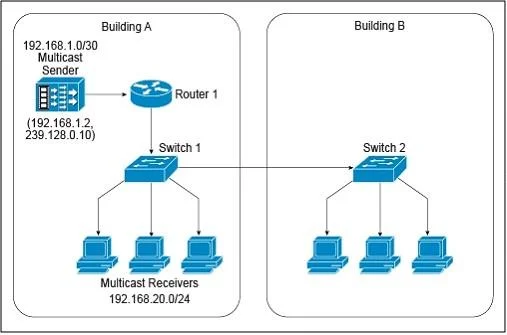
Options
- AEnable PIM snooping on both Layer 2 switches.
- BEnable multicast storm control on the link between Switch 1 and Switch 2.
- CUse static Layer 2 MAC forwarding entries on Switch 1.
- DChange the IPv4 multicast group address such that it excludes the usage of link-local MAC
- EEnsure that Switch 1 is an IGMP querier.
How the community answered
(37 responses)- A22% (8)
- B11% (4)
- C3% (1)
- D57% (21)
- E8% (3)
Why each option
IPv4 multicast group addresses in the 224.0.0.0/24 range map to link-local Layer 2 MAC addresses that switches are required to flood regardless of IGMP snooping configuration, so changing to a non-link-local address resolves the flooding.
PIM snooping optimizes the handling of PIM join/prune messages on Layer 2 switches but does not override the hardware requirement to flood link-local MAC-addressed frames, so the root cause remains.
Multicast storm control rate-limits multicast traffic volume but does not perform membership-based forwarding decisions, so traffic would still be sent toward Building B, only at a reduced rate.
Static Layer 2 MAC forwarding entries can direct specific multicast MACs to specific ports but do not address the link-local MAC flooding behavior and require ongoing manual maintenance as the topology changes.
Multicast addresses in the 224.0.0.0/24 range resolve to link-local MAC addresses (01:00:5e:00:00:00 through 01:00:5e:00:00:ff), which IEEE standards require Layer 2 switches to always flood out all ports - IGMP snooping has no authority to suppress traffic destined to these MACs. Changing the multicast group to an address outside the 224.0.0.0/24 range (for example in the administratively scoped 239.x.x.x block) produces a non-link-local destination MAC, enabling IGMP snooping to properly track receivers and block forwarding to Building B when no members are present.
Configuring Switch 1 as an IGMP querier ensures snooping tables are populated when no external querier is present, but even with fully populated snooping tables the switch will still flood frames whose destination MAC is in the link-local range.
Concept tested: IGMP snooping bypass caused by link-local multicast MAC addresses
Source: https://www.cisco.com/c/en/us/td/docs/ios-xml/ios/ipmulti_igmp/configuration/xe-16/imc-igmp-xe-16-book/imc-igmp-snoop.html
Topics
Community Discussion
No community discussion yet for this question.