
350-801 · Question #518
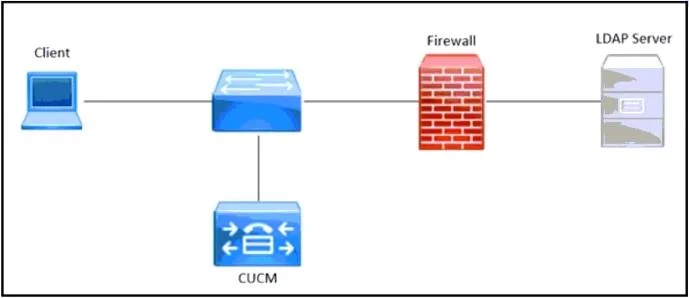
Refer to the exhibit. An engineer must configure Cisco UCM to sync with an LDAP server. After the LDAP configuration is complete, the authentication times out before Cisco UCM logs in. Which port…
The correct answer is D. 389. To resolve LDAP authentication timeouts during Cisco UCM synchronization, firewall port 389 must be open. This port is essential for unencrypted Lightweight Directory Access Protocol (LDAP) communication between CUCM and the LDAP server.
Question
Refer to the exhibit. An engineer must configure Cisco UCM to sync with an LDAP server. After the LDAP configuration is complete, the authentication times out before Cisco UCM logs in. Which port must be open on the firewall to resolve the issue?
Exhibit
Options
- A3389
- B123
- C161
- D389
How the community answered
(29 responses)- A3% (1)
- B7% (2)
- C3% (1)
- D86% (25)
Why each option
To resolve LDAP authentication timeouts during Cisco UCM synchronization, firewall port 389 must be open. This port is essential for unencrypted Lightweight Directory Access Protocol (LDAP) communication between CUCM and the LDAP server.
Port 3389 is used for Remote Desktop Protocol (RDP) and is unrelated to LDAP synchronization or authentication.
Port 123 is used for Network Time Protocol (NTP), which is important for time synchronization but not for LDAP directory services.
Port 161 is used for Simple Network Management Protocol (SNMP), which is used for network device monitoring and management, not for LDAP.
The default port for Lightweight Directory Access Protocol (LDAP), which Cisco UCM uses to synchronize with an LDAP server, is 389. If this port is blocked on the firewall between Cisco UCM and the LDAP server, the synchronization and authentication process will time out, preventing successful user login or directory updates.
Concept tested: LDAP port for directory synchronization
Source: https://www.cisco.com/c/en/us/td/docs/voice_ip_comm/cucm/install/10_0_1/cucm_b_install-cucm-100/cucm_b_install-cucm-100_chapter_0110.html
Topics
Community Discussion
No community discussion yet for this question.