
350-801 · Question #164
Refer to the exhibit. An administrator is attempting to register a SIP phone to a Cisco UCM but the registration is failing. The IP address of the SIP Phone is 10.117.34 222 and the IP 1 address of…
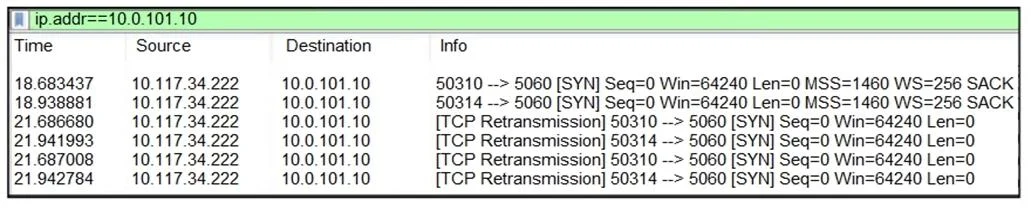
The correct answer is D. An network device is blocking TCP port 5060 from the SIP phone to the Cisco UCM. This. When a SIP phone cannot register with Cisco UCM despite successful pings, it strongly indicates a blocked application-layer port. TCP port 5060 is the standard port for SIP registration, and a network device blocking this port would prevent the phone from establishing a SIP…
Question
Refer to the exhibit. An administrator is attempting to register a SIP phone to a Cisco UCM but the registration is failing. The IP address of the SIP Phone is 10.117.34 222 and the IP 1 address of the Cisco UCM is 10.0.101.10. Pings from the SIP phone to the Cisco UCM are successful. What is the cause of this issue and how should it be resolved?
Exhibit
Options
- AThe certificates on the SIP phone are not trusted by the Cisco UCM. The SIP phone must
- BDNS lookup for the Cisco UCM FQDN is failing. The SIP phone must be reconfigured with the
- CAn NTP mismatch is preventing connection of the TCP session between the SIP phone and
- DAn network device is blocking TCP port 5060 from the SIP phone to the Cisco UCM. This
How the community answered
(24 responses)- A4% (1)
- B8% (2)
- C17% (4)
- D71% (17)
Why each option
When a SIP phone cannot register with Cisco UCM despite successful pings, it strongly indicates a blocked application-layer port. TCP port 5060 is the standard port for SIP registration, and a network device blocking this port would prevent the phone from establishing a SIP session with UCM.
While certificate issues can cause SIP registration failures, especially for secure SIP (TLS on port 5061), a blocked port 5060 for standard SIP is a more fundamental and common cause when basic IP connectivity is confirmed by pings.
The problem statement indicates successful pings to the UCM's IP address, suggesting that basic network path resolution to the UCM is functioning. If the phone is configured with the UCM's IP address, DNS lookup for an FQDN is not necessarily the immediate issue preventing TCP connection establishment.
NTP mismatches can lead to various communication issues, including certificate validation failures, but they are less likely to prevent the initial TCP session from being established on the correct port than a direct port block.
Successful pings confirm basic network connectivity between the SIP phone and Cisco UCM at the IP layer. However, SIP registration relies on specific transport ports, commonly TCP port 5060 (or 5061 for SIP over TLS). If a network device, such as a firewall or ACL, is blocking TCP port 5060 between the SIP phone and the Cisco UCM, the SIP registration messages cannot reach the UCM, causing the registration to fail. Resolving this requires opening the necessary TCP port.
Concept tested: SIP phone registration troubleshooting - port connectivity
Source: https://www.cisco.com/c/en/us/td/docs/voice_ip_comm/cucm/admin/12_5_1/systemConfig/cucm_b_system-configuration-guide-1251/cucm_b_system-configuration-guide-1251_chapter_0100.html
Topics
Community Discussion
No community discussion yet for this question.