
350-601 · Question #589
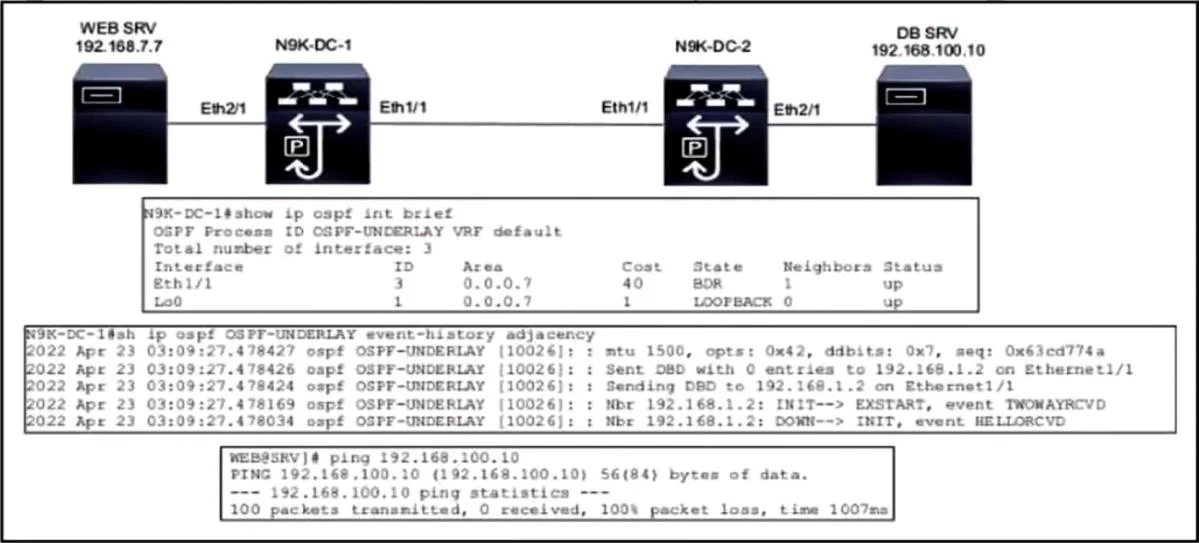
Refer to the exhibit. An engineer must optimize the OSPF database between the N9K-DC-2 and N9K-DC-1 switches by using a direct link between them. After the configuration changes are made on the…
The correct answer is B. ip ospf mtu-ignore. When a direct link is added between N9K-DC-1 and N9K-DC-2 and OSPF is enabled on it, an MTU mismatch between the two interfaces can cause the OSPF adjacency to stall in the Exstart or Exchange state. In this state, the switches exchange DBD (Database Description) packets but…
Question
Refer to the exhibit. An engineer must optimize the OSPF database between the N9K-DC-2 and N9K-DC-1 switches by using a direct link between them. After the configuration changes are made on the N9K-DC-2 switch, the WEB server that is connected to N9K-DC-1 can no longer forward IPv4 unicast packets to the database server connected to the N9K-DC-2. Which command must be used on the N9K-DC-1 to resolve the issue?
Exhibit
Options
- Aip router ospf OSPF-UNDERLAY area 0.0.0.0
- Bip ospf mtu-ignore
- Cip ospf network point-to-point
- Dip ospf priority 255
How the community answered
(28 responses)- A4% (1)
- B86% (24)
- C7% (2)
- D4% (1)
Explanation
When a direct link is added between N9K-DC-1 and N9K-DC-2 and OSPF is enabled on it, an MTU mismatch between the two interfaces can cause the OSPF adjacency to stall in the Exstart or Exchange state. In this state, the switches exchange DBD (Database Description) packets but cannot complete the database synchronization, so no routes are exchanged-causing the loss of reachability to the database server. The command ip ospf mtu-ignore on the N9K-DC-1 interface disables MTU checking in OSPF DBD packets, allowing the adjacency to form despite the mismatch. This is the most targeted fix for this specific symptom; the other options address priority, network type, or area assignment, none of which cause this failure mode.
Topics
Community Discussion
No community discussion yet for this question.