
350-601 · Question #386
Refer to the exhibit. SVR-A in EPG-A/BD-A fails to reach SVR-B in EPG-B/BD-B. Which two conditions should be verified to analyze the traffic between the two EPGs? (Choose two.)
The correct answer is A. A contract exists between EPG-A and EPG-B and allows the traffic. C. SVR-B is learned as an endpoint in EPG-B from Node-112. When two endpoints in different Endpoint Groups (EPGs) within Cisco ACI fail to communicate, it is crucial to verify the existence of a contract allowing traffic between those EPGs and confirm that both endpoints are correctly learned within their respective EPGs.
Question
Refer to the exhibit. SVR-A in EPG-A/BD-A fails to reach SVR-B in EPG-B/BD-B. Which two conditions should be verified to analyze the traffic between the two EPGs? (Choose two.)
Exhibit
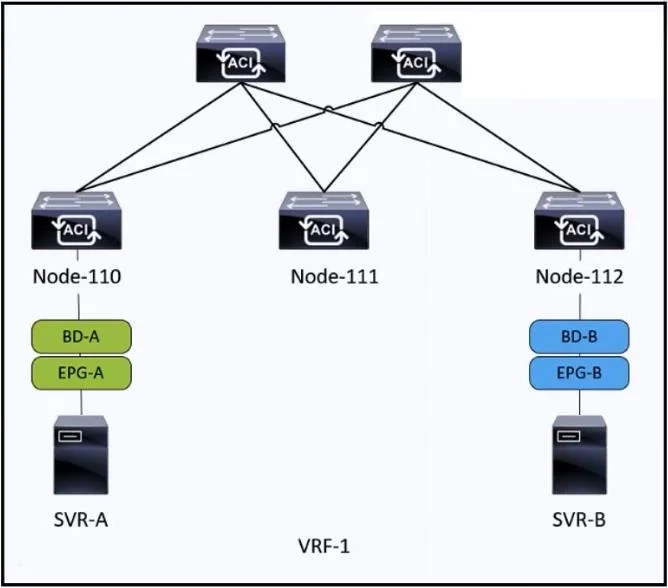
Options
- AA contract exists between EPG-A and EPG-B and allows the traffic.
- BLimit Endpoint Learning is disabled on the bridge domain for EPG-B.
- CSVR-B is learned as an endpoint in EPG-B from Node-112.
- DEPG-A and EPG-B are excluded from the preferred group.
- EThe bridge domain for EPG-B floods ARP packets.
How the community answered
(57 responses)- A77% (44)
- B4% (2)
- D14% (8)
- E5% (3)
Why each option
When two endpoints in different Endpoint Groups (EPGs) within Cisco ACI fail to communicate, it is crucial to verify the existence of a contract allowing traffic between those EPGs and confirm that both endpoints are correctly learned within their respective EPGs.
In Cisco ACI, communication between endpoints in different EPGs is governed by contracts. If SVR-A and SVR-B are in different EPGs (EPG-A and EPG-B), a contract must exist between them that permits the specific traffic flow (e.g., ICMP, HTTP) for communication to succeed.
Limit Endpoint Learning (also known as Unicast Routing) controls whether the Bridge Domain performs IP learning; disabling it would not directly prevent traffic, and it's generally enabled for IP routing.
For any endpoint to communicate within or across EPGs, it must first be learned by the ACI fabric. Verifying that SVR-B is learned as an endpoint in EPG-B from its connected leaf (Node-112) confirms the fabric is aware of the server's location and can properly forward traffic to it.
Whether EPG-A and EPG-B are excluded from a preferred group primarily affects contract enforcement within a VRF, not necessarily the fundamental ability of a contract to allow traffic.
While ARP flooding is necessary for endpoints to learn each other's MAC addresses within the same broadcast domain, this is an underlying mechanism; the primary issues for inter-EPG communication failure are typically contracts and endpoint learning.
Concept tested: Cisco ACI inter-EPG communication troubleshooting
Source: https://www.cisco.com/c/en/us/td/docs/aci/apic/5x/troubleshooting/cisco-aci-troubleshooting-guide-50.html
Topics
Community Discussion
No community discussion yet for this question.