
350-601 · Question #291
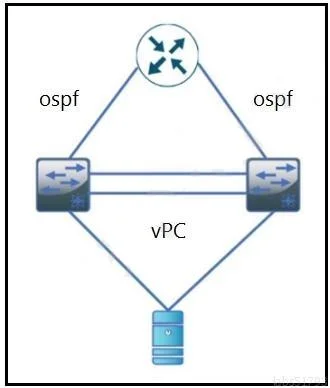
Refer to the exhibit. During a vPC peer switch reload, there is packet loss between the server and the router. Which action must be taken to prevent this behavior during future reloads?
The correct answer is B. Increase the vPC delay restore timer. After a vPC peer device reloads and comes back up, the routing protocol needs time to The recovering vPCs leg may black-hole routed traffic from access to core until Layer 3 connectivity is reestablished. vPC Delay Restore feature delays vPCs leg bringup on the recovering vPC…
Question
Refer to the exhibit. During a vPC peer switch reload, there is packet loss between the server and the router. Which action must be taken to prevent this behavior during future reloads?
Exhibit
Options
- ASet the routed uplink ports of the Cisco Nexus peers as orphans.
- BIncrease the vPC delay restore timer.
- CDisable vPC ARP synchronize on the vPC peers.
- DDecrease the OSPF hello and dead interval timers.
How the community answered
(26 responses)- A4% (1)
- B81% (21)
- C4% (1)
- D12% (3)
Explanation
After a vPC peer device reloads and comes back up, the routing protocol needs time to The recovering vPCs leg may black-hole routed traffic from access to core until Layer 3 connectivity is reestablished. vPC Delay Restore feature delays vPCs leg bringup on the recovering vPC peer device. vPC Delay Restore allows for Layer 3 routing protocols to converge before allowing any traffic on vPC Result is a more graceful restoration and zero packet loss during the recovery phase (traffic still get diverted on the alive vPC peer device). This feature is enabled by default with a vPC restoration default timer of 30 seconds. The timer can be tuned according to a specific Layer 3 convergence baseline from 1 to 3600 seconds. practices_design_guide.pdf
Topics
Community Discussion
No community discussion yet for this question.