
350-501 · Question #99
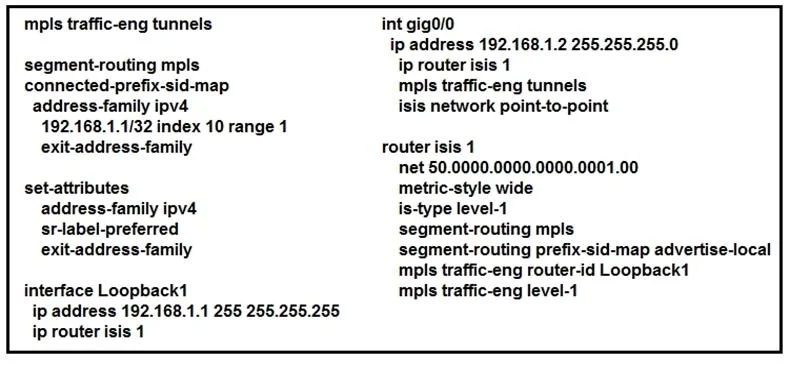
Refer to the exhibit. Which statement about this configuration is true?
The correct answer is D. It is the configuration for the head-end router of a Cisco MPLS TE tunnel with segment routing. The configuration snippet describes the head-end router setup for a Cisco MPLS Traffic Engineering (TE) tunnel that utilizes Segment Routing for dynamic path computation.
Question
Refer to the exhibit. Which statement about this configuration is true?
Exhibit
Options
- AIt requires an explicit Cisco MPLS TE path to be configured for the tunnel to run
- BIt requires OSPF to also be running to have optimized Cisco MPLS TE tunnels
- CIt requires a dynamic Cisco MPLS TE path to be configured for the tunnel to run
- DIt is the configuration for the head-end router of a Cisco MPLS TE tunnel with segment routing
How the community answered
(38 responses)- A11% (4)
- B5% (2)
- C3% (1)
- D82% (31)
Why each option
The configuration snippet describes the head-end router setup for a Cisco MPLS Traffic Engineering (TE) tunnel that utilizes Segment Routing for dynamic path computation.
The 'dynamic segment-routing' keyword specifies a dynamically computed path, not an explicit (static) one.
While OSPF is often used in conjunction with MPLS TE and Segment Routing, the configuration itself doesn't inherently require OSPF for the tunnel to run.
The configuration does include a dynamic path option, but option D is a more complete and accurate description of the entire setup including segment routing and head-end.
The configuration snippet including 'tunnel destination', 'tunnel mode mpls traffic-eng', and crucially 'tunnel mpls traffic-eng path-option 10 dynamic segment-routing' explicitly defines the head-end of an MPLS TE tunnel. The 'dynamic segment-routing' keyword indicates that the tunnel's path is dynamically computed using Segment Routing capabilities.
Concept tested: MPLS TE tunnel head-end configuration with Segment Routing
Source: https://www.cisco.com/c/en/us/td/docs/ios-xml/ios/sr/configuration/xe-16/sr-xe-16-book/implement-sr-mpls-te.html
Topics
Community Discussion
No community discussion yet for this question.