
350-501 · Question #621
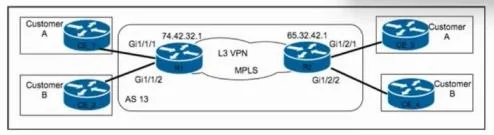
Refer to the exhibit. A Tier-2 ISP provides MPLS Layer 3 VPNs to customers throughout the region. BGP and OSPF are used as routing protocols in the backbone, and all routers are running Cisco IOS-XE…
The correct answer is C. Configure address-family ipv6 unicast under the VRF configuration. D. Configure route-target both 1441:3421 under the address family configuration. To configure the IPv6 private connection for Customer A on R1, the engineer must enable the IPv6 unicast address family under the VRF and configure route targets for proper route exchange.
Question
Refer to the exhibit. A Tier-2 ISP provides MPLS Layer 3 VPNs to customers throughout the region. BGP and OSPF are used as routing protocols in the backbone, and all routers are running Cisco IOS-XE software. Customer A has requested a private connection between two of its offices. The company has plans to interconnect more offices across the country soon, so the solution should allow for the addition of new sites without reconfiguring the existing sites. The customer is using an IPv6 addressing scheme. R1 has been preconfigured with vrf definition Customer_A and assigned rd 1441:3421. Which two tasks should the engineer perform on R1 to configure the private connection? (Choose two.)
Exhibit
Options
- AConfigure address-family unicast ipv6 Customer_A under the BGP configuration.
- BConfigure export route-target 1441:3421 under the VRF configuration.
- CConfigure address-family ipv6 unicast under the VRF configuration.
- DConfigure route-target both 1441:3421 under the address family configuration.
- EConfigure address-family unicast ipv6 vrf Customer_A under the OSPF configuration.
How the community answered
(36 responses)- A8% (3)
- B3% (1)
- C72% (26)
- E17% (6)
Why each option
To configure the IPv6 private connection for Customer A on R1, the engineer must enable the IPv6 unicast address family under the VRF and configure route targets for proper route exchange.
The command 'address-family unicast ipv6 Customer_A' is not a standard BGP configuration; address families are typically configured as 'address-family ipv6 unicast' within the BGP routing process or under the VRF.
Configuring 'export route-target 1441:3421' only specifies route export, not import, which would prevent other PEs from importing Customer A's routes.
Configuring 'address-family ipv6 unicast' under the VRF definition allows the VRF to handle IPv6 routing for customer prefixes, isolating them from the global routing table.
Configuring 'route-target both 1441:3421' under the BGP VRF address family ensures that routes associated with this VRF are both exported from and imported into other PEs with the same route target, facilitating VPN connectivity.
The command 'address-family unicast ipv6 vrf Customer_A' is not a valid OSPF configuration; OSPF is typically configured per interface or per area within a VRF, not using this address-family format for VRF.
Concept tested: MPLS Layer 3 VPN IPv6 configuration
Source: https://www.cisco.com/c/en/us/td/docs/ios-xml/ios/iproute_bgp/configuration/xe-16/irg-xe-16-book/bgp-mpls-vpn.html
Topics
Community Discussion
No community discussion yet for this question.