
350-501 · Question #606
Refer to the exhibit. Users on a LAN connected to router R5 frequently open high-traffic connections with servers connected to R1 and R4. Users on R2 also require access to the servers, but…
The correct answer is C. Implement LLQ for the whole network with a strict policy to ensure that all traffic from the servers is. To mitigate congestion and improve performance for high-priority server traffic on the R2-R4 link while allowing other traffic to flow, Low Latency Queuing (LLQ) should be implemented to strictly prioritize critical traffic.
Question
Refer to the exhibit. Users on a LAN connected to router R5 frequently open high-traffic connections with servers connected to R1 and R4. Users on R2 also require access to the servers, but performance is not a major concern and their traffic can be treated as secondary. As traffic on all links grows, the network architect wants to mitigate the potential for congestion on the link between R2 and R4. Which action must the engineering team take to improve performance on the R2-R4 link for users on R5 while still allowing other traffic to flow?
Exhibit
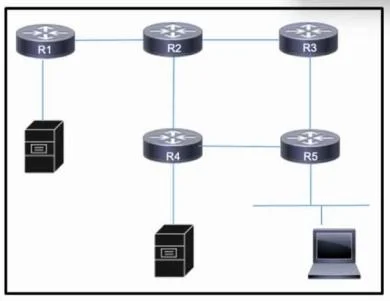
Options
- AImplement traffic policing on R2 to drop unnecessary traffic from secondary users when that traffic
- BImplement traffic shaping on R2 to control transmission between R1 and R4 for traffic identified in
- CImplement LLQ for the whole network with a strict policy to ensure that all traffic from the servers is
- DImplement FIFO on R1, R2, and R4 to queue traffic so that all traffic can pass with maximum
How the community answered
(44 responses)- A5% (2)
- B2% (1)
- C84% (37)
- D9% (4)
Why each option
To mitigate congestion and improve performance for high-priority server traffic on the R2-R4 link while allowing other traffic to flow, Low Latency Queuing (LLQ) should be implemented to strictly prioritize critical traffic.
Traffic policing drops excess traffic, which can control secondary users but does not proactively guarantee improved performance or specific priority for high-priority server traffic.
Traffic shaping smooths out traffic bursts by delaying excess packets but does not provide strict prioritization or preferential forwarding for specific high-priority flows over others on a congested link.
Implementing Low Latency Queuing (LLQ) allows for strictly prioritizing critical traffic flows, such as high-traffic connections from servers, ensuring they receive preferential treatment and minimal latency on congested links like R2-R4, even when other secondary traffic is present.
FIFO (First-In, First-Out) queuing processes all packets in the order they arrive without any prioritization, making it ineffective for improving performance for specific high-priority traffic during congestion.
Concept tested: QoS Low Latency Queuing (LLQ)
Source: https://www.cisco.com/c/en/us/td/docs/ios/qos/configuration/guide/qos_c/qc_llq.html
Topics
Community Discussion
No community discussion yet for this question.