
350-501 · Question #602
Refer to the exhibit. The network is running OSPF, and access to the internet is provided through RF. User traffic is growing, and the engineering team wants to mitigate the future potential for…
The correct answer is A. Implement MPLS and install a Cisco MPLS TE tunnel to route high-priority traffic via a preferred. To mitigate congestion from growing server traffic and maintain better network performance, implementing MPLS Traffic Engineering (TE) tunnels allows for explicitly routing high-priority traffic along preferred or less congested paths.
Question
Refer to the exhibit. The network is running OSPF, and access to the internet is provided through RF. User traffic is growing, and the engineering team wants to mitigate the future potential for congestion when the servers are experiencing heavy use. Which action must the team take to maintain better network performance?
Exhibit
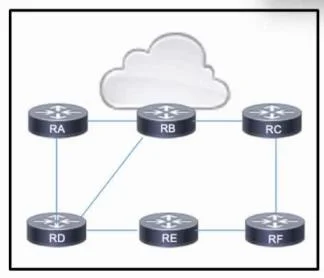
Options
- AImplement MPLS and install a Cisco MPLS TE tunnel to route high-priority traffic via a preferred
- BImplement ACLs to manage traffic flowing over individual links.
- CImplement class maps to categorize traffic and apply them to policies to manage traffic flow.
- DImplement OSPF point-to-point links to eliminate the need for DR election and the associated
How the community answered
(49 responses)- A78% (38)
- B12% (6)
- C4% (2)
- D6% (3)
Why each option
To mitigate congestion from growing server traffic and maintain better network performance, implementing MPLS Traffic Engineering (TE) tunnels allows for explicitly routing high-priority traffic along preferred or less congested paths.
MPLS Traffic Engineering (TE) tunnels provide explicit control over traffic paths, allowing an engineer to bypass standard IGP shortest-path routing and direct high-priority server traffic through specific, less congested, or preferred network links, thereby mitigating future congestion.
ACLs are used for security filtering and access control, not for traffic engineering or directing traffic over specific paths to manage congestion.
Class maps and policy maps (QoS) prioritize or shape traffic on existing links but do not change the fundamental routing path of traffic across the network to relieve congestion.
Implementing OSPF point-to-point links simplifies OSPF adjacency formation by eliminating DR/BDR elections but does not provide mechanisms for traffic engineering or congestion mitigation through explicit path selection.
Concept tested: MPLS Traffic Engineering for congestion management
Source: https://www.cisco.com/c/en/us/td/docs/ios-xml/ios/iproute_mpls/configuration/xe-16/irm-xe-16-book/irm-mpls-te-overview.html
Topics
Community Discussion
No community discussion yet for this question.