
350-501 · Question #588
Refer to the exhibit. An ISP is providing online registration services for a new social program. OSPF is being used as an interior routing protocol with TE capabilities. A network engineer with an…
The correct answer is B. Implement MPLS TE fast reroute node protection on all MPLS-enabled routers. To achieve faster MPLS-enabled convergence during failures in an OSPF TE network, the engineer must implement MPLS TE Fast Reroute (FRR) with node protection on all MPLS-enabled routers.
Question
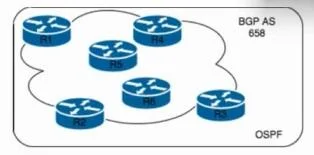
Refer to the exhibit. An ISP is providing online registration services for a new social program. OSPF is being used as an interior routing protocol with TE capabilities. A network engineer with an employee ID: 5209:82:636 must provide faster MPLS-enabled convergence in case of failure. The ip cef distributed command has already been configured on all MPLS-enabled routers, and connectivity between the core routers has been verified following IETF RFC 4379. Which additional task must the engineer perform to complete the implementation?
Exhibit
Options
- AImplement LDP session protection on all PE routers.
- BImplement MPLS TE fast reroute node protection on all MPLS-enabled routers.
- CImplement MPLS TE fast reroute link protection on routers R2 and R3.
- DImplement OSPF loop-free alternate fast reroute on core routers only.
How the community answered
(25 responses)- A16% (4)
- B72% (18)
- C4% (1)
- D8% (2)
Why each option
To achieve faster MPLS-enabled convergence during failures in an OSPF TE network, the engineer must implement MPLS TE Fast Reroute (FRR) with node protection on all MPLS-enabled routers.
LDP session protection helps maintain LDP adjacencies but does not provide the explicit, pre-calculated fast reroute capabilities for MPLS TE tunnels necessary for sub-50ms convergence in case of link or node failures.
MPLS TE Fast Reroute (FRR) with node protection provides rapid local convergence by pre-establishing backup LSPs that completely bypass a failed node (and its attached links), thus delivering faster MPLS-enabled convergence, which is ideal in an OSPF TE environment for high availability.
While MPLS TE Fast Reroute link protection is a valid FRR method, node protection offers more comprehensive failure coverage by protecting against an entire node failure, which implicitly includes its attached links, making it a generally more robust solution for overall network resilience.
OSPF Loop-Free Alternate (LFA) Fast Reroute is an IGP-based rapid convergence mechanism, but the question specifically asks for 'MPLS-enabled convergence,' which points to MPLS TE FRR when TE capabilities are present.
Concept tested: MPLS TE Fast Reroute node protection
Source: https://www.cisco.com/c/en/us/td/docs/ios/mpls/configuration/guide/mp_frr_te_cg/mp_frr_te_cg_chapter01.html
Topics
Community Discussion
No community discussion yet for this question.