
350-501 · Question #583
Refer to the exhibit. OSPF is running in the given network. R1 was previously running EIGRP on a standalone network, and a network engineer just migrated it to OSPF. The R1 peering with R2 has come…
The correct answer is A. Implement a route map that matches the rules in an ACL from Area 2, and then attach the route. To prevent R2 from receiving routes specifically from OSPF Area 2 while accepting routes from Area 0 and Area 1, the engineer must implement a route map on R2 that matches routes from Area 2 using an ACL, and then apply this filter.
Question
Refer to the exhibit. OSPF is running in the given network. R1 was previously running EIGRP on a standalone network, and a network engineer just migrated it to OSPF. The R1 peering with R2 has come up. Which additional action must the engineer take so that R2 receives routes from Area 1 and Area 0 but it is prevented from receiving routes from Area 2?
Exhibit
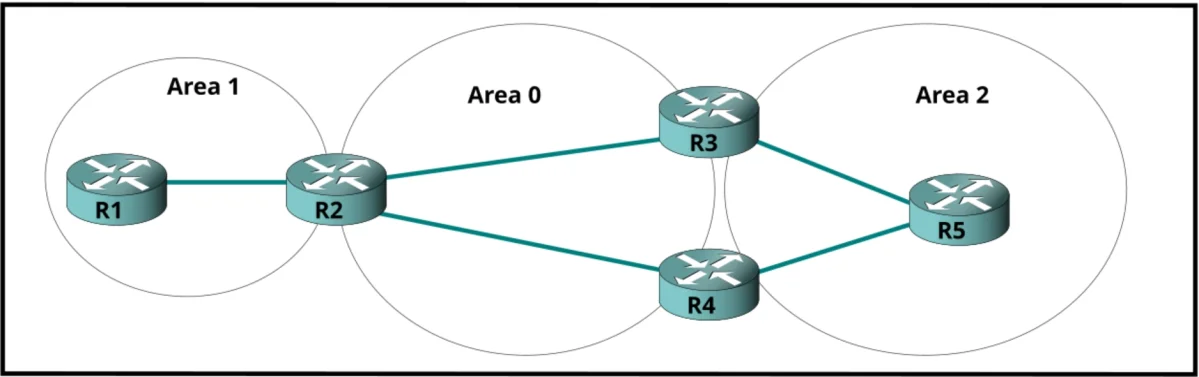
Options
- AImplement a route map that matches the rules in an ACL from Area 2, and then attach the route
- BImplement a route map that matches R1's next-hop address. and then attach the route map to an
- CImplement a route map that matches R2's interface to R3 and R4, and then attach the route map
- DImplement a route map that matches the routes from Area 2 in a prefix list, and then attach the
How the community answered
(19 responses)- A84% (16)
- B11% (2)
- C5% (1)
Why each option
To prevent R2 from receiving routes specifically from OSPF Area 2 while accepting routes from Area 0 and Area 1, the engineer must implement a route map on R2 that matches routes from Area 2 using an ACL, and then apply this filter.
Implementing a route map that references an Access Control List (ACL) to identify routes originating from Area 2, and then applying this route map as a filter (e.g., using `distribute-list in` or `area filter-list` on R2 as an ABR), is a standard and effective method to prevent specific OSPF routes from being installed in R2's routing table.
Filtering OSPF routes based on a next-hop address (R1's) is not a practical or comprehensive method for preventing an entire area's routes from being received or installed in the routing table.
Matching R2's interfaces to R3 and R4 in a route map is irrelevant to filtering routing updates based on their originating OSPF area.
While a prefix list is commonly used with route maps for route matching, the correct answer specifically states using an ACL, which is also a valid and frequently used method for defining route filtering criteria in OSPF.
Concept tested: OSPF inter-area route filtering
Source: https://www.cisco.com/c/en/us/support/docs/ip/open-shortest-path-first-ospf/13697-29.html
Topics
Community Discussion
No community discussion yet for this question.