
350-501 · Question #569
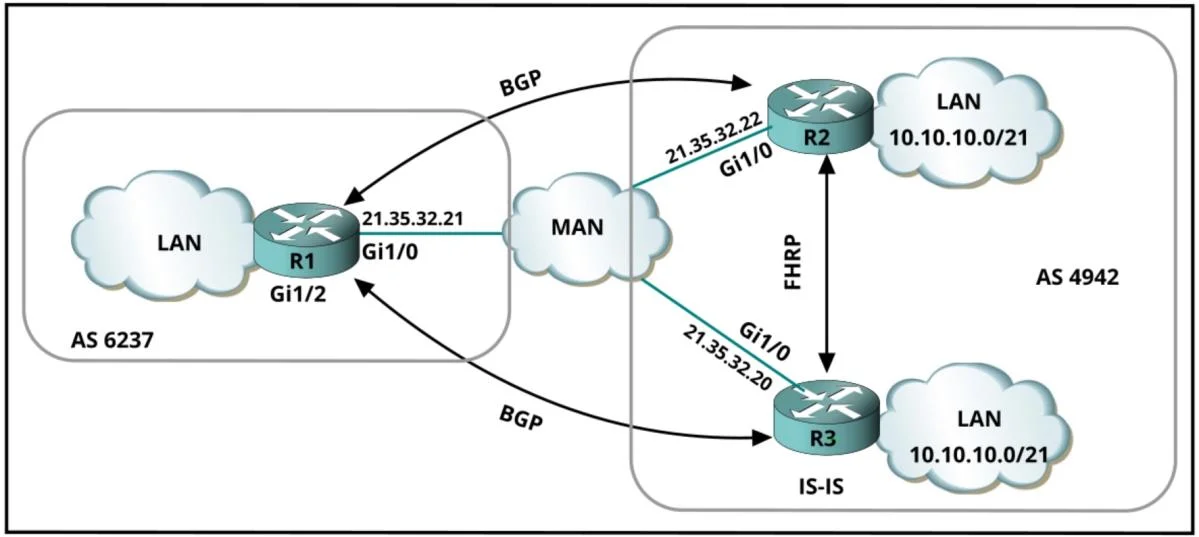
Refer to the exhibit. Company Ahas three routers on its campus. IS-IS is used as an interior routing protocol in AS 4942. Routers R1 and R2 are located in the IS-IS Level 1 area, and they have been…
The correct answer is B. Implement the route map with set ip next-hop 21.23.32.25. C. Implement a route map with bgp address-family ipv4 route-map in under the BGP configuration. To ensure R1 maintains communication to the external 10.10.10.0/21 subnet via the VRRP VIP in case of an R2 or R3 failure, R1 must configure a BGP inbound route map. This route map should modify the next-hop of received BGP routes destined for 10.10.10.0/21 to the VRRP Virtual…
Question
Refer to the exhibit. Company Ahas three routers on its campus. IS-IS is used as an interior routing protocol in AS 4942. Routers R1 and R2 are located in the IS-IS Level 1 area, and they have been configured with redistribute isis level-1-2 under address-family ipv4. R2 and R3 have a VRRP configuration on their external-facing interfaces with VIP address 21.23.32.25. A network engineer must ensure that communication to subnet 10.10.10.0/21 is maintained if either of the routers in AS 4942 fail. Which two tasks must the engineer perform on R1 to achieve the goal? (Choose two.)
Exhibit
Options
- AImplement a route map with route-map out under the BGP configuration.
- BImplement the route map with set ip next-hop 21.23.32.25.
- CImplement a route map with bgp address-family ipv4 route-map in under the BGP configuration.
- DImplement the route map with set bgp next-hop 21.23.32.25.
- EImplement the route map with set ip bgp next-hop-self.
How the community answered
(41 responses)- A12% (5)
- B54% (22)
- D7% (3)
- E27% (11)
Why each option
To ensure R1 maintains communication to the external 10.10.10.0/21 subnet via the VRRP VIP in case of an R2 or R3 failure, R1 must configure a BGP inbound route map. This route map should modify the next-hop of received BGP routes destined for 10.10.10.0/21 to the VRRP Virtual IP (VIP), directing traffic to the active VRRP router.
Implementing a `route-map out` would affect routes R1 advertises, not routes it receives, and thus would not help R1 maintain connectivity to external subnets if an upstream router fails.
The `set ip next-hop 21.23.32.25` command within a route map changes the BGP next-hop attribute of the routes to point to the VRRP Virtual IP. This ensures that internal traffic from R1, destined for 10.10.10.0/21 (assumed to be an external subnet for this solution), is always sent to the active VRRP gateway (either R2 or R3), providing failover capability.
Applying the route map with `bgp address-family ipv4 route-map <map-name> in` ensures that routes for the external subnet 10.10.10.0/21, when received by R1 (likely from R2 via iBGP), are processed and their next-hop attribute is modified as they are installed into R1's BGP table. This allows R1 to direct traffic to the redundant VRRP VIP.
While `set bgp next-hop` also sets the BGP next-hop, `set ip next-hop` is the more conventional and direct command for specifying a literal IP address as the next-hop in a route map for BGP. In this context, `set ip next-hop` is the precise command to use.
The `set ip bgp next-hop-self` command changes the next-hop to the advertising router's own IP address, which is not the VRRP VIP required for redundancy to external subnets.
Concept tested: BGP route map for next-hop modification and VRRP integration
Source: https://www.cisco.com/c/en/us/td/docs/ios-xml/ios/iproute_pi/configuration/xe-3s/iri-xe-3s-book/iri-rm-bgp-pi.html
Topics
Community Discussion
No community discussion yet for this question.