
350-501 · Question #511
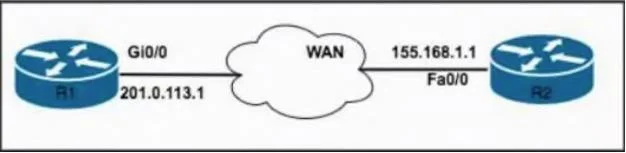
Refer to the exhibit. Router R1 in the network has a GigabitEthernet interface supporting 1 Gbps of bandwidth, and R2 has a FastEthemet interface. Both devices are connected to a WAN network as…
The correct answer is D. Implement Traffic Policing In the network to guarantee sufficient VoIP traffic throughput. To ensure quality for VoIP traffic, which is latency-sensitive, the engineer must implement traffic policing to control the rate of traffic flow and ensure it does not exceed the allocated bandwidth. By marking VoIP traffic with DSCP value EF (Expedited Forwarding) and…
Question
Refer to the exhibit. Router R1 in the network has a GigabitEthernet interface supporting 1 Gbps of bandwidth, and R2 has a FastEthemet interface. Both devices are connected to a WAN network as shown. To ensure seamless data flow, both routers have BGP routing enabled with the WAN ISP. To better handle a recent increase in VoIP traffic, a network engineer must identify VoIP traffic and mark it with DSCP value EF to guarantee bandwidth of 500 Kbps. Which action must the engineer take to meet the requirements?
Exhibit
Options
- AImplement Priority Queuing on R1 to reduce traffic latency for VoIP traffic.
- BImplement Weighted Fair Queuing on R2 to minimizing queuing delays for VoIP traffic.
- CImplement Class-Based Shaping in the network to ensure VoIP traffic quality.
- DImplement Traffic Policing In the network to guarantee sufficient VoIP traffic throughput.
How the community answered
(39 responses)- A15% (6)
- B8% (3)
- C3% (1)
- D74% (29)
Explanation
To ensure quality for VoIP traffic, which is latency-sensitive, the engineer must implement traffic policing to control the rate of traffic flow and ensure it does not exceed the allocated bandwidth. By marking VoIP traffic with DSCP value EF (Expedited Forwarding) and enforcing a 500 Kbps bandwidth guarantee, the network prioritizes VoIP traffic while maintaining efficient use of available bandwidth.
Topics
Community Discussion
No community discussion yet for this question.