
350-501 · Question #504
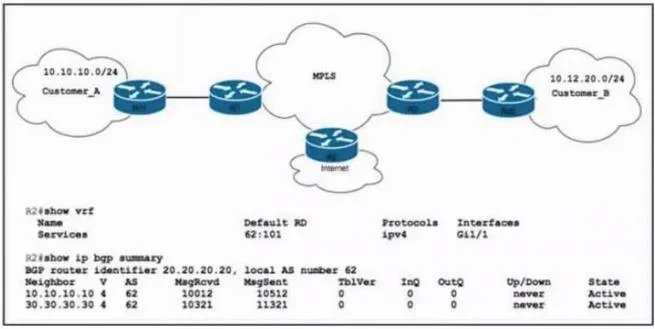
Refer to the exhibit. ISP_A is about to launch a new internet service. ISP_A is already providing MPLS VPN Layer 3 services to Customer_A and Customer_B, which are connected to ISP_A via OSPF. A…
The correct answer is A. Import route-target 62:101 into the customer VRFs on R1 and R3. In MPLS Layer 3 VPN, route targets are used to control the exchange of routes between VRFs. Based on the exhibit: 1. R2 already has the VRF Services configured with RD 62:101. 2. To complete the setup and enable the proper routing for Customer_A and Customer_B, the same…
Question
Refer to the exhibit. ISP_A is about to launch a new internet service. ISP_A is already providing MPLS VPN Layer 3 services to Customer_A and Customer_B, which are connected to ISP_A via OSPF. A network engineer completed the BGP and VRF configurations on R2 to support the new internet service. Which additional action completes the launch?
Exhibit
Options
- AImport route-target 62:101 into the customer VRFs on R1 and R3
- BImplement the BGP routing protocol in the customer VRFs on R1 and R2
- CEnable the route-replicate command under the customer VRFs on R1 and R2
- DActivate NAT CE in the customer VRFs on R1, R2, and R3
How the community answered
(14 responses)- A86% (12)
- C7% (1)
- D7% (1)
Explanation
In MPLS Layer 3 VPN, route targets are used to control the exchange of routes between VRFs. Based on the exhibit: 1. R2 already has the VRF Services configured with RD 62:101. 2. To complete the setup and enable the proper routing for Customer_A and Customer_B, the same route-target 62:101 needs to be imported into the respective VRFs on R1 and R3. This ensures that the routes in the Services VRF are shared across all devices in the VPN, allowing communication between Customer_A, Customer_B, and the internet service.
Topics
Community Discussion
No community discussion yet for this question.