
350-501 · Question #495
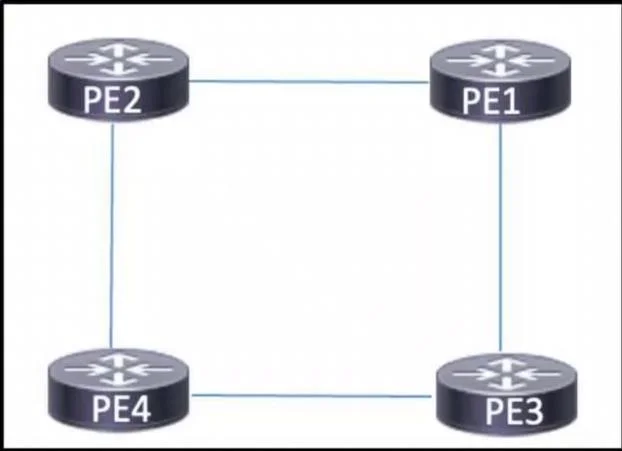
Refer to the exhibit. The four PE routers in the network are connected and running OSPF to share routes. MPLS is enabled on the four routers. The routers are connected and configured to use /30…
The correct answer is A. Configure the devices to establish LDP neighbor relationships to share label information. To support Layer 3 VPNs in an MPLS environment, Label Distribution Protocol (LDP) is required to establish label-switched paths (LSPs) between the Provider Edge (PE) routers. These LSPs are used to forward labeled traffic through the network. Configuring LDP neighbor…
Question
Refer to the exhibit. The four PE routers in the network are connected and running OSPF to share routes. MPLS is enabled on the four routers. The routers are connected and configured to use /30 networks. A network engineer must implement Layer 3 VPN support for traffic between customer sites. Which task must the engineer perform?
Exhibit
Options
- AConfigure the devices to establish LDP neighbor relationships to share label information.
- BDeploy IGP in the network to exchange intranet data between the PEs.
- CUpdate the subnet between each router to a /24 prefix.
- DImplement MPLS
How the community answered
(40 responses)- A90% (36)
- B5% (2)
- C3% (1)
- D3% (1)
Explanation
To support Layer 3 VPNs in an MPLS environment, Label Distribution Protocol (LDP) is required to establish label-switched paths (LSPs) between the Provider Edge (PE) routers. These LSPs are used to forward labeled traffic through the network. Configuring LDP neighbor relationships - Label information is exchanged between adjacent routers. - MPLS forwarding tables are populated to enable end-to-end transport of VPN traffic. Tasks like deploying IGP (already done here via OSPF) or creating MPLS TE tunnels are unnecessary for basic MPLS Layer 3 VPN functionality. Updating the subnet to /24 is not relevant for MPLS VPNs, as /30 subnets are sufficient for point-
Topics
Community Discussion
No community discussion yet for this question.