
350-501 · Question #489
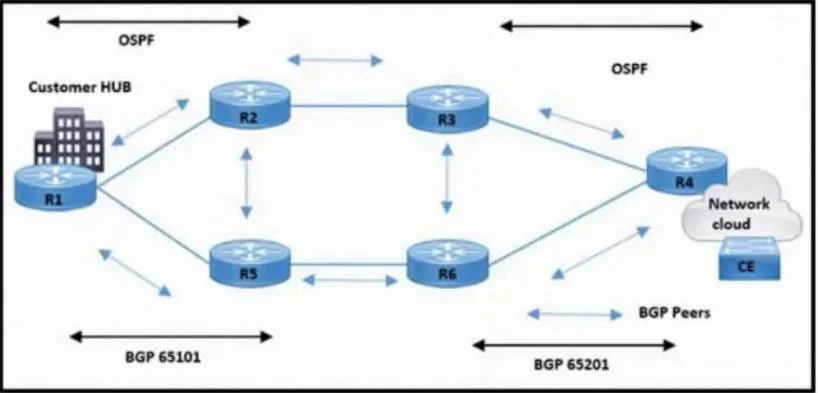
Refer to the exhibit. The NOC is configuring PE router R4 in the network for BGP-originated traffic. R4 is connected to a CE device at a customer location. The customer provided these requirements…
The correct answer is A. Set the BGP peering with ha-mode sso. To meet the Non-Stop Routing (NSR) requirement and ensure continuous packet forwarding during events like ISSU (In-Service Software Upgrade) or RP (Route Processor) switchover, enabling BGP high-availability mode with Stateful Switchover (SSO) is required. Setting ha-mode sso…
Question
Refer to the exhibit. The NOC is configuring PE router R4 in the network for BGP-originated traffic. R4 is connected to a CE device at a customer location. The customer provided these requirements:
- BGP peers must establish a neighborship with NSR and NSF capability.
- BGP must maintain the state with the CE device and provide continuous
packet forwarding during ISSU and RP switchover events. Which action meets the NSR requirement on PE routers?
Exhibit
Options
- ASet the BGP peering with ha-mode sso.
- BSet the BGP stalepath-time to 360 seconds.
- CSet the BGP administrative distance to 15 for BGP neighbors.
- DSet the BGP restart-time to 120 seconds.
How the community answered
(18 responses)- A78% (14)
- B6% (1)
- C6% (1)
- D11% (2)
Explanation
To meet the Non-Stop Routing (NSR) requirement and ensure continuous packet forwarding during events like ISSU (In-Service Software Upgrade) or RP (Route Processor) switchover, enabling BGP high-availability mode with Stateful Switchover (SSO) is required. Setting ha-mode sso ensures that the BGP session is seamlessly maintained between R4 and the CE device without interruptions during control plane failovers, while the data plane continues forwarding
Topics
Community Discussion
No community discussion yet for this question.